

How to Create Your Own Graphic Tee (Without Crying Over a Design App)
So, you want to create your own graphic tee? Amazing. The short version is this: come up with an idea that's actually funny, pop it into a simple design tool like Canva, pick a printing method, and let a print-on-demand service handle the rest. You can go from a random shower thought to a real-life, wearable shirt in just a few days. You’ve earned it.
Brainstorming a Tee That's Actually Funny
Let’s be real—you’ve got a genius, coffee-spittingly funny t-shirt idea rattling around in that brilliant brain of yours. It’s that one perfect phrase that sums up your entire existence, a hilarious observation about your cat's questionable life choices, or an inside joke that absolutely deserves to go public.
The hard part? Turning that flicker of comedic gold into a design that actually lands. This isn’t about chasing trends or slapping a generic meme on a shirt. It's about finding your unique voice.
Find Your Comedic Goldmine
The best novelty tees come from real life. Stop trying to invent jokes and just start paying attention to the absurdity all around you. Your personal experiences are a bottomless well of relatable content.
Think about these potential goldmines:
- Your Daily Frustrations: That thing your partner does with the dishwasher? The soul-crushing dread of a Monday morning meeting? The sheer chaos of toddler logic? These are universal pains that make for amazing mom life shirts or just plain relatable gear.
- Weirdly Specific Observations: What’s a strange thought you’ve had that you assumed no one else shared? Chances are, thousands of people have thought the exact same thing. That’s where the magic happens.
- Inside Jokes: Got a hilarious one-liner that makes your friends cry-laugh? It might just be niche enough to build a cult following. The goal isn’t to please everyone; it’s to make the right people feel seen.
Pro Tip: Keep a running list on your phone. Whenever a funny thought strikes, jot it down. Most will be duds, but you’ll eventually strike gold. Don’t filter yourself—just capture the raw idea.
Test Your Material (Gently)
Once you have a few solid contenders, it’s time for a reality check. Before you commit to a full-blown design, run it by a trusted friend. And not just any friend—you need the one who will give you brutally honest feedback, not just a polite nod.
Ask them, “Would you actually wear this, or at least laugh if you saw it on someone else?” Their gut reaction is everything. If they hesitate or give you a confused look, it’s probably back to the drawing board.
If you need a little extra inspiration to get the gears turning, check out some of our favorite funny t-shirt slogans for ideas on what makes a phrase stick.
Ultimately, the best designs come from a place of authenticity. Create something that genuinely makes you laugh, and you’ll find your people.
Designing Your Shirt (Even if You Can't Draw)
So, you’re not a graphic designer. Big deal. You don’t need a fancy art degree or a laptop that sounds like a jet taking off to make a killer graphic tee. Honestly, most of us are working with more enthusiasm than actual Adobe Illustrator skills, and that’s perfectly fine.
The great news? You don't need them. Tools like Canva or Kittl are your new best friends. They were built for regular people who just want to create cool stuff without spending a semester learning about kerning (it’s a font thing, don't worry about it).
Picking Your Tools and Fonts
First things first, let's talk fonts. The font you choose is basically your shirt's entire personality. Is it bold and in-your-face? Or is it more of a quiet, sarcastic whisper?
Whatever you do, for the love of all that is holy, step away from Comic Sans. Unless the joke is literally about how awful Comic Sans is, just don't.
Here’s a quick cheat sheet for getting the vibe right:
- Bold & Punchy: Perfect for those short, hilarious one-liners that need to be read from across the room.
- Script & Quirky: Great for adding a personal, handwritten feel to more clever or observational humor.
- Simple & Clean: When the words are doing all the heavy lifting, a classic, easy-to-read font is always the right call.
You can pair your text with simple graphics, but don't go overboard. Sometimes, a single, perfectly chosen icon is all it takes to elevate a joke from a chuckle to a full-on snort-laugh. If you're looking for inspiration on how to nail that balance, checking out some well-loved cute t-shirt designs can show you how simple graphics and text make a winning combo.
Decoding the Tech Stuff (It's Easier Than It Sounds)
Now for the "scary" part that isn't actually scary at all. You’ll hear people throw around terms like "vector" and "PNG." Think of it this way:
A vector file (like an .SVG, .AI, or .EPS) is basically magic. It’s made of math formulas instead of tiny dots, which means you can stretch it to the size of a billboard and it will never get blurry. This is the gold standard for printers because it guarantees a super crisp, clean print every single time.
A PNG file is your next-best option. Its superpower is having a transparent background, so you won't get a big, ugly white box printed around your design. Just make sure it’s high-resolution—at least 300 DPI (dots per inch)—or it’ll look fuzzy and amateur. A JPEG, on the other hand, almost always has a solid background and can look pixelated. Just avoid it.
Getting your file "print-ready" just means saving it as a high-quality vector or PNG, making sure the background is transparent, and sizing it correctly for the shirt. That's it. You've officially graduated from Design 101.
Before you send your masterpiece off to the printer, run through this dead-simple checklist:
- Is my spelling and grammar perfect? (A typo is a joke killer.)
- Is the file a high-res PNG or a vector?
- Is the background transparent?
- Did I double-check how the design looks on different shirt colors?
Nail these four things, and you're all set for a perfect print.
Choosing Your Canvas: The Perfect Tee and Print Method
A brilliant design on a scratchy, boxy shirt is a modern tragedy. Seriously. You did all that work to come up with a hilarious one-liner, only to print it on something that feels like a cardboard box with armholes.
Let’s not do that.
First, let's talk about the shirt itself. The fabric is the foundation of your entire project. If you want that buttery-soft, "I've owned this for years" feel right out of the box, 100% ringspun cotton is your best friend. It’s what we use for our shirts because comfort is non-negotiable.
For a tee that needs to survive the apocalypse (or just a really intense workout), a durable poly-blend offers more stretch and moisture-wicking power.
Finding The Right Print For Your Punchline
Once you’ve picked your perfect canvas, it's time to figure out how to get your design onto it. The printing method you choose can make or break your final product, impacting everything from the feel of the graphic to the overall cost. It's a bigger deal than you might think.
Here are the main contenders:
- Direct-to-Garment (DTG): Think of this as a super-fancy inkjet printer for fabric. It’s perfect for detailed, multi-color designs because the ink soaks directly into the fibers, leaving a soft, breathable finish. This is the go-to for one-off prints or small batches of novelty tees with complex graphics. You can find out everything you ever wanted to know by checking out our deep dive on what Direct-to-Garment printing is.
- Screen Printing: This is the OG method. It involves pushing ink through a stencil onto the fabric. It’s incredibly durable and cost-effective for large batches of a simple design (think one or two colors). If you’re planning to print 50 shirts for a family reunion, this is your winner.
- Heat Transfer: The DIY hero. You print your design onto special paper and use a heat press (or a very brave iron) to transfer it to the shirt. It's great for quick, at-home projects, but the quality and durability can be a bit of a gamble compared to professional methods.
Choosing the right method comes down to three things: your design’s complexity, how many shirts you need, and your budget. Don't cheap out on the print if you've got a masterpiece on your hands.
To make it even easier, here’s a quick rundown of how these popular methods stack up against each other.
Printing Methods At A Glance
| Method | Best For | Feel & Durability | Typical Cost |
|---|---|---|---|
| Direct-to-Garment (DTG) | Detailed, multi-color designs and small batches. Great for photos or complex art. | Very soft feel, as ink soaks into the fabric. Good durability. | Higher per-shirt cost for one-offs; gets cheaper in small bulk. |
| Screen Printing | Simple graphics (1-3 colors) and large quantities (25+ shirts). | Ink sits on top of the fabric. Very durable, can outlast the shirt. | Low per-shirt cost for large runs, but high initial setup fees. |
| Heat Transfer (Vinyl/Paper) | DIY projects, prototypes, or single custom shirts. | The design sits on top of the shirt; can feel stiff or plasticky. Varies in durability. | Low setup cost, but cost per shirt doesn't drop much with quantity. |
Ultimately, for single hilarious tees with tons of color, DTG is usually the way to go. For a big batch of your brand's logo, screen printing is king.
You're Not Alone In This Tee-Making Journey
If you're wondering whether this is all worth the effort, let’s look at the numbers. The custom t-shirt printing market is absolutely exploding. One analysis projects it to grow from $8.17 billion in 2024 to over $13.55 billion by 2029. That massive growth is all thanks to people like you who want unique, personalized gear, confirming now is the perfect time to bring your funny t-shirt ideas to life.
This decision tree helps visualize whether your file is ready for a crisp, professional print.
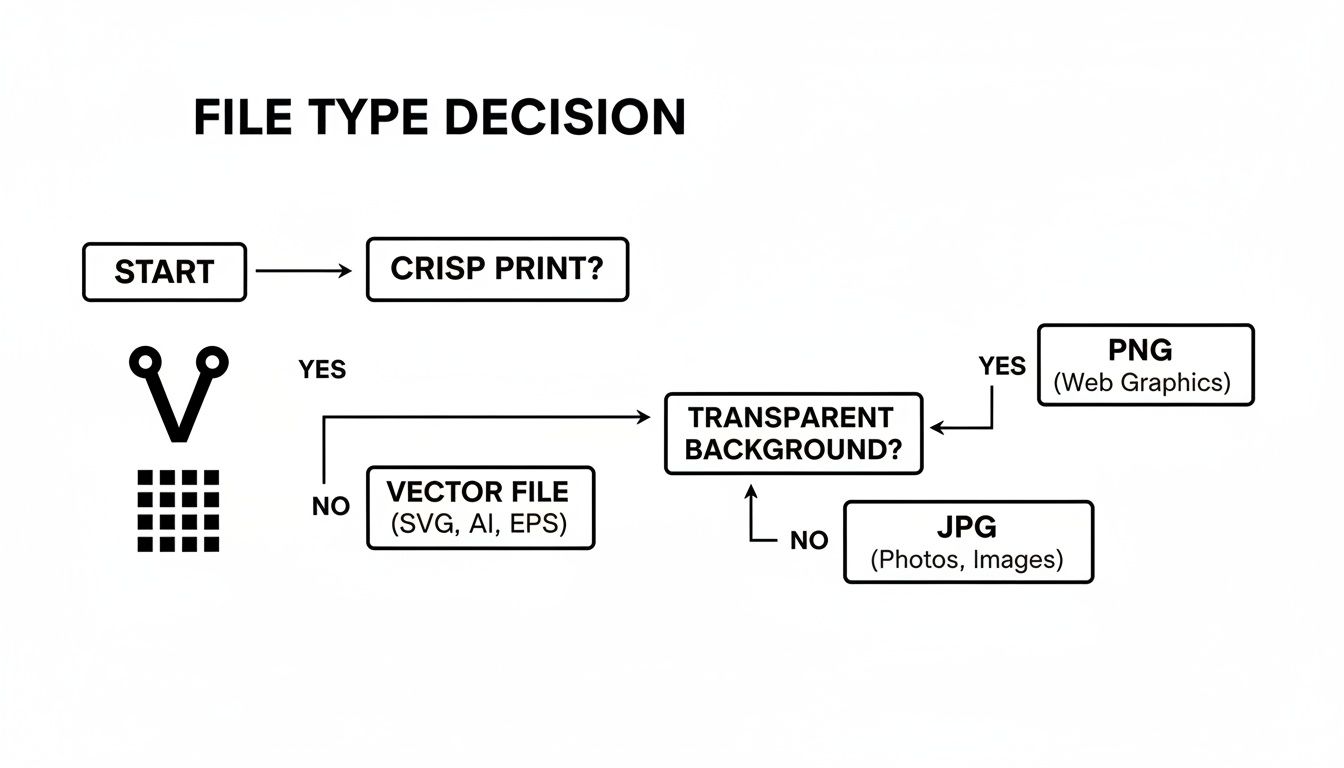
The bottom line? A vector file is the foolproof choice for a sharp print, while a high-resolution PNG is a solid backup.
Bringing Your Masterpiece to Life
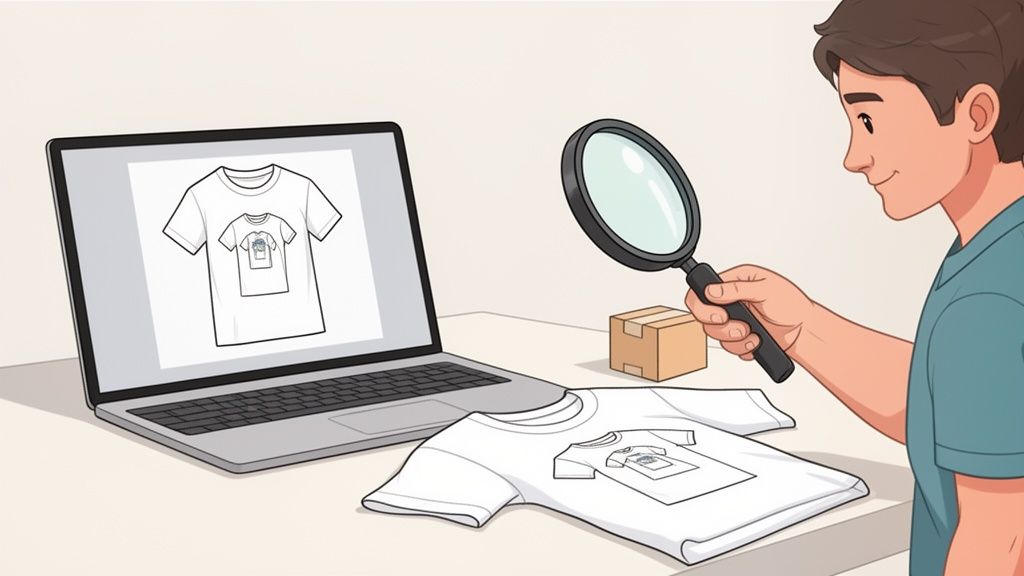
Alright, your killer design is done, the file is ready to go, and you’re on the home stretch. This is where the real fun begins—turning that digital file into a physical, wearable, and ridiculously funny t-shirt. Let's get this thing printed.
But before you hit that big green "order" button, there’s one step you absolutely cannot skip: the mockup. Think of it as a digital dress rehearsal for your shirt. It’s a preview that shows you exactly how your design will look on an actual tee, complete with wrinkles, shadows, and all.
This isn't just about making it look pretty for a website. It’s a crucial quality check. A mockup helps you spot potential disasters before they cost you real money. Is the text way too big? Is the graphic sitting awkwardly low? Does your masterpiece that looked amazing on a white background completely vanish on a black shirt? A good mockup answers all these questions for you.
Mockups: Your First Line of Defense
Creating a mockup is way easier than it sounds. Most print-on-demand services have built-in mockup generators that do all the heavy lifting. You just upload your design, pick a shirt color, and bam—instant preview. For more control, you can use tools like Placeit or find Photoshop templates.
Here's what to eyeball on your mockup:
- Placement: The sweet spot is usually the upper chest. Too high and it’s a choker; too low and it’s a belly print. Neither is a good look.
- Scale: Does the design feel balanced on the shirt? It shouldn't be so massive it wraps into the armpits or so tiny you need a magnifying glass to read it.
- Color Contrast: Don't just check it on your favorite color. Test the design on multiple shirt colors to make sure it’s readable and looks good on everything you plan to offer.
Print on Demand vs. Local Shops
Once your mockup gets the green light, it’s decision time. How are you actually going to get this shirt printed? Your two main routes are using a Print-on-Demand (POD) service or finding a local print shop.
Print-on-Demand is a total game-changer if you want to create your own graphic tee without turning your garage into a warehouse. You connect your design to an online service like Printful or Printify, and they handle everything—printing, packing, and shipping—only when an order comes in. There’s zero upfront cost and no inventory risk. You can order just one shirt for yourself or set up an entire online store.
The rise of digital printing like Direct-to-Garment (DTG) is what makes POD possible. This tech, which is growing at about 12% annually, lets companies print on demand, slashing inventory costs for everyone. It’s how brands like us can drop fresh, relatable shirts every single week without taking a huge financial gamble. You can get the full scoop on this market trend from Grand View Research.
On the other hand, a local print shop is fantastic if you need a big batch of shirts for an event, your family reunion, or your beer league team. You’ll almost always get a better price-per-shirt on bulk orders, plus you get to support a local business and see physical samples. The catch? Most shops have minimum order requirements, making it a tough choice for a one-off project.
For a single funny t-shirt experiment, POD is the smarter, easier choice 99% of the time.
Or Skip the Hassle and Shop With Us
Look, we get it. You've just walked through the entire creative process—from brainstorming jokes to navigating design software and weighing printing methods. You basically deserve a medal.
But let's be real. What if you could just skip straight to the good part?
At Laugh Riot Tees, we live and breathe funny t-shirts. Our whole mission is to create those perfectly witty, relatable shirts that make people smile. No design stress, no file prep headaches—just pure, unadulterated humor delivered right to your door.
Soft Shirts, Fresh Designs & Free Shipping
Every one of our designs is printed on ridiculously soft, high-quality shirts that feel like an old favorite from day one. Life is chaotic enough without dealing with scratchy, uncomfortable clothes. Our tees are built to survive laundry day, toddler meltdowns, and those spontaneous coffee spills that are basically a daily ritual.
We drop brand-new designs every single week, so your wardrobe never gets stale. From mom life shirts that hit a little too close to home to novelty tees that perfectly capture your internal monologue, there’s always something fresh to discover.
Figuring out what makes a great tee can be a journey, so we've put together some tips on where to buy funny shirts that are actually worth your money.
And because surprise fees are the worst kind of joke, we offer free shipping on every single order.
You’ve done enough work. Treat yourself and let us handle the hard part. Your new favorite shirt is waiting.
Your Top T-Shirt Questions Answered
Alright, you've got the idea, you've got the drive, but a few nagging questions are holding you back from launching your t-shirt empire. We get it. Let’s tackle the most common things people ask before they decide to create your own graphic tee.
Think of this as your final pep talk—with a side of slightly sarcastic but genuinely useful advice.
What's the Best File Format for a T-Shirt Design?
If you want a print that looks ridiculously crisp and professional, a vector file is king. No contest. Formats like .AI, .EPS, or .SVG are pure magic because you can stretch them to the size of a billboard and they won't lose a single drop of quality. Your printer will basically send you a thank you card.
Can't get a vector? Your next best bet is a high-resolution PNG file with a transparent background. And when we say high-res, we mean at least 300 DPI. Please, for the love of all things comfy, stay away from JPEGs. They usually have a solid background and can turn your masterpiece into a sad, pixelated mess.
How Much Does It Cost to Make One Custom T-Shirt?
The price for a single shirt can jump around a lot, but you’re usually looking at somewhere between $20 and $40. That number really depends on a few things:
- The Print Method: For a one-off shirt, Direct-to-Garment (DTG) is almost always the go-to.
- The Blank Shirt: A buttery-soft, premium tee is going to cost more than a standard one that feels like you're wearing a cardboard box.
- Your Design's Complexity: Sometimes, a design with a bajillion colors can nudge the price up.
Honestly, using a Print-on-Demand service is the easiest and most cost-effective way to get just one killer tee made without breaking the bank.
The Bottom Line: You don’t need to sell a kidney to make one shirt. But spending a little extra on a quality blank and a solid print is the difference between a shirt you wear once and a shirt you live in.
What Are the Most Common Mistakes to Avoid?
Oh, the t-shirt horror stories we could tell. Here are the top three rookie mistakes we see all the time that can absolutely wreck an otherwise brilliant funny t-shirt:
- Using a Low-Resolution Image: This is the cardinal sin of t-shirt design. A blurry, pixelated print just screams amateur hour. Always, always start with the highest quality file you can possibly get your hands on.
- Placing the Design Too Low: It’s a classic blunder. The design looks fine on your screen, but once it's printed, it ends up looking like a belly button decal. Aim for the upper chest area—it’s the sweet spot for a flattering, professional look.
- Ignoring the Shirt Color: That sick black design looked amazing on your white mockup, right? Well, it’s going to be completely invisible on a black shirt. Always preview your design on every single shirt color you plan to sell.
You've got the knowledge, you've got the power. Now go make something hilarious. Or, you know, just let the pros at Laugh Riot Tees handle it for you. We’ve already got the softest shirts and the funniest jokes, all ready to go.