

T-Shirt Tsunami: A No-Nonsense Guide to Inventory Management for Small Business
Let’s be real. That little stack of funny t-shirts you started with has officially staged a coup and taken over your living room. A solid inventory management plan for your small business is the secret weapon to reclaim your space and turn that chaotic pile into cold, hard cash. This isn't about getting bogged down in boring spreadsheets; it's about knowing exactly what you have, what you need, and where the heck it’s all going.
Conquering Your T-Shirt Mountain

Welcome to the club. One minute you’re dreaming up hilarious, relatable shirt designs, and the next, you’re playing a high-stakes game of Jenga with boxes full of inventory. This isn't just a hobby that got out of hand—it’s a business. And learning to manage your stock is what separates a profitable brand from a very expensive new decorating scheme.
Think of inventory management as your brand's bouncer. It decides what comes in, what goes out, and makes damn sure you don't have 500 extra-smalls of a "mom life" shirt that nobody wants. Getting this right is your ticket to freedom—freedom from stress, lost sales, and the gut-punch of telling a customer their favorite novelty tee is sold out.
Why You Can’t Just Wing It
Ignoring your inventory is like driving with your eyes closed. It might work for a second, but you know it’s going to end badly. You’re definitely not alone in this struggle, though. It turns out a huge number of small businesses are flying blind—a staggering 43% don't actively monitor their inventory at all. Even wilder, 21% admit to having no system whatsoever, proving chaos is a surprisingly popular business model. You can see more stats like these over at ProcurementTactics.com.
When you don’t track your stock, you're practically asking for trouble:
- Running out of best-sellers: Nothing kills your momentum faster than a "sold out" sign on your most popular funny t-shirt.
- Wasting money on duds: You’ll end up with piles of shirts that aren't selling, tying up cash you could use for fresh, new designs.
- Shipping nightmares: Sending the wrong size or color because you grabbed the wrong tee from the pile is a quick way to earn a one-star review and a frustrated customer.
The goal isn’t to become a logistics expert overnight. It’s to create a simple, repeatable system that saves you time and sanity so you can get back to creating shirts that make people laugh.
Mastering the basics of inventory management for your small business is less about complex formulas and more about common sense. It's about knowing your assets and making them work for you. Before we dive into the how-to, let's cut through some of the jargon you might see.
I've translated some of the boring corporate-speak into plain English that actually makes sense for a t-shirt hustler like you. Getting these terms down will give you a solid foundation for everything that follows.
Inventory Terms Translated for T-Shirt Hustlers
| Boring Term | What It Actually Means |
|---|---|
| SKU (Stock Keeping Unit) | The unique code for each product variation. "Funny-Dog-Tee-Red-Large" is a SKU. It’s how you tell one shirt from another. |
| COGS (Cost of Goods Sold) | How much it cost you to get a shirt ready to sell. This includes the blank tee, the printing, and any other direct costs. |
| Inventory Turnover | How many times you sell through your entire stock in a year. A high number means shirts are flying off the shelves. |
| Safety Stock | The extra pile of your best-sellers you keep on hand just in case you get a sudden rush of orders. Your "oh crap" buffer. |
| Lead Time | The time it takes from when you order more blank tees from your supplier to when they actually land on your doorstep. |
| Reorder Point | The inventory level that screams, "Hey, order more of this shirt now before you run out!" |
Once you get comfortable with these ideas, managing your stock becomes a whole lot less intimidating. You're just counting shirts and making sure you have enough of the good stuff.
Getting Your T-Shirt Empire in Order
If your current inventory system is yelling, “Where’s that ‘Mom Life’ shirt in large?!” into a messy pile of boxes, it’s time for an intervention. A good organization system isn't about being a neat freak—it's about saving your sanity and making more money.
Think of it as a much-needed makeover for your stockroom. A little bit of logic here will stop you from accidentally shipping a sarcastic cat shirt to a dog lover. Proper inventory management for a small business starts with a simple setup, whether you're working from a garage corner or a small warehouse. You just need to know what you have and where to find it in seconds.
Meet Your New Best Friend: The SKU
A SKU, or Stock Keeping Unit, sounds super corporate and boring, but it's actually a secret code that will make your life ridiculously easy. It’s a unique ID you create for every single product variation you sell.
And yes, I mean every single one. That "Tired as a Mother" tee in black, size medium, is a completely different beast from the same shirt in size large.
Why bother? Because a solid SKU system is the bedrock of tracking your inventory. It tells you, your spreadsheet, or your software exactly what just sold, what needs a restock, and what’s been collecting dust since last year.
Without SKUs, you're just guessing. With them, you're a business owner who has their stuff together. It's the difference between organized chaos and just… chaos.
Creating them is way easier than it sounds. The key is to be consistent and logical. A simple, bulletproof formula for t-shirts looks like this:
[Design Abbreviation] - [Color Abbreviation] - [Size]
Let's break that down with a few shirts you probably have in your shop:
-
Example 1: Your best-selling "Caffeine & Chaos" design.
- SKU: CC-BLK-M (Caffeine & Chaos, Black, Medium)
-
Example 2: A popular "Grill Sergeant" dad shirt.
- SKU: GS-NVY-XL (Grill Sergeant, Navy, Extra-Large)
-
Example 3: That funny "I Run on Coffee and Dry Shampoo" tee.
- SKU: CDS-HTG-S (Coffee Dry Shampoo, Heather Gray, Small)
See? It’s a simple language that instantly tells you what the product is. Just write down your formula and stick to it like glue. This consistency is what makes your entire inventory process run smoothly, cutting down on errors and saving you from having to look things up manually.
Arranging Your Physical Space for Speed
Okay, your products have their own unique names. Now it's time to give them a home. Organizing your physical storage space doesn’t require a fancy warehouse system; it just requires a plan. The goal here is to make picking and packing orders as fast and foolproof as possible.
Start by labeling everything. Your shelves, your bins, your boxes—they all get a label. This isn't just for you; it's for your spouse, friend, or kid who you rope into helping you when that viral TikTok video sends sales through the roof.
Here’s a practical way to set up your space:
- Group by Design First: Give each t-shirt design its own dedicated shelf or section. All your "Caffeine & Chaos" shirts live in one spot, and all the "Grill Sergeant" tees live in another. This stops you from running all over the place for a single order.
- Then, Organize by Size: Within each design’s area, arrange the shirts by size. A simple small-to-large flow (S, M, L, XL, etc.) is the most common and effective method. It creates a natural path when you're grabbing different sizes for an order.
- Use Clear Bins (If You Can): This is a game-changer. Using clear plastic bins lets you see the product inside, saving you from opening a dozen identical cardboard boxes to find that one heather gray tee. Slap a label with the SKU on the outside of the bin for lightning-fast identification.
This simple setup transforms your inventory from a pile of potential headaches into a well-oiled machine. When an order for a "CC-BLK-M" comes in, you know exactly where to go. You’ll walk to the "Caffeine & Chaos" shelf, find the black tees, and grab a medium. No frantic searching, no mistakes, just fast, accurate fulfillment that keeps your customers happy and coming back for more.
Knowing When to Reorder Your Best-Sellers
Let's be real. Running out of your best-selling "mom life" shirt during the holiday shopping frenzy is a special kind of nightmare. It's the small business equivalent of showing up to a party and realizing you forgot your pants. We’re going to make sure that never, ever happens to you again.
This is all about predicting the future without a crystal ball. By looking at what you've already sold, you can make some seriously smart guesses about what people will want to buy next. Good inventory management for a small business isn't magic; it's about math—but the easy kind, I promise.
The No-Panic Reordering Formula
The secret to never running out of stock boils down to two key ideas: the reorder point and safety stock. They might sound like terms from a stuffy business textbook, but they’re actually your best friends in the t-shirt game.
Think of it this way: your reorder point is the alarm clock that tells you it's time to order more shirts. It’s that specific number of tees left on your shelf that should trigger a call to your supplier. Your safety stock is your emergency stash—the "just in case" pile that protects you from a sudden surge in orders or a supplier delay.
Here’s the simple formula to figure it out:
Reorder Point = (Average Daily Sales x Supplier Lead Time in Days) + Safety Stock
Let's break that down with one of your most relatable shirts.
- Your Product: "I Run on Coffee and Sarcasm" Tee
- Average Daily Sales: You sell about 5 of these shirts a day.
- Supplier Lead Time: It takes your t-shirt supplier 10 days to print and ship your order to you.
- Safety Stock: You want to keep an extra 15 shirts on hand to cover any surprises (like if a celebrity is suddenly spotted wearing it).
Now, let's do the math: (5 shirts/day x 10 days) + 15 shirts = 65 shirts.
This means that as soon as your inventory for that tee drops to 65 units, it's time to place a new order. By the time your last safety stock shirt is sold, your fresh batch should be arriving. No stress, no missed sales.
Don't Forget About Seasonality
Your inventory needs aren't the same year-round, and your reordering strategy has to reflect that. That sarcastic Santa shirt probably won't be flying off the shelves in July, but you’ll want a mountain of them come November. This is where seasonality comes in.
To get a handle on this, just look at your sales data from last year.
- Identify Your Peaks: When did certain designs spike? Was it Mother's Day for your mom life shirts? Back-to-school? The holidays?
- Adjust Your Averages: When calculating your average daily sales, use data from that specific season. Your daily average for a holiday tee in December might be 20, while its average for the rest of the year is practically zero.
- Order Ahead: For predictable seasonal rushes, order your stock well in advance. Supplier lead times can get longer during busy periods, so planning ahead is everything.
This simple infographic shows how a new t-shirt variation is born—the very first step before you can even think about reordering.
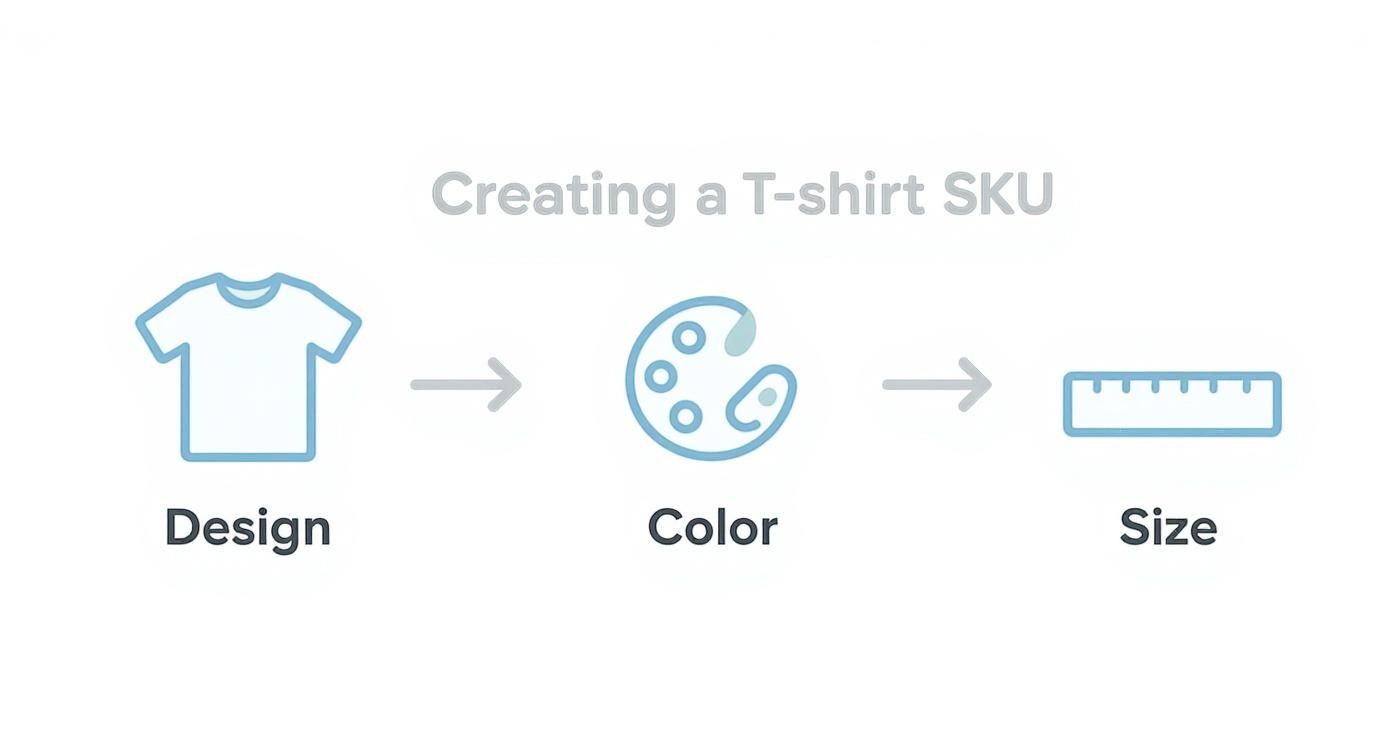
Each step—from the initial design to choosing colors and sizes—creates a new SKU that needs its own reorder point.
Keeping Cash Flow Healthy
Smart reordering isn't just about avoiding stockouts; it's about managing your cash. Over-ordering ties up your money in inventory that’s just sitting there, collecting dust. That’s cash you could be using to design new funny t-shirts or run a marketing campaign.
By using reorder points, you’re investing in inventory exactly when you need it. This keeps your cash flowing and ensures you’re putting your money into the products that are actually making you money. It’s a proactive approach that helps you stay lean and profitable.
Want to see which designs are consistently at the top of their game? Check out our collection of top-sellers to get an idea of the kinds of shirts that customers can't get enough of. Understanding these trends can make your own forecasting even more accurate.
Keeping Your Inventory Count Accurate

Okay, let's be honest: nobody fantasizes about spending their weekend counting t-shirts. But you know what's even less fun? Finding out the numbers in your spreadsheet are a work of fiction and you’ve been losing money for months.
Keeping your inventory count accurate is a non-negotiable part of a solid inventory management for small business strategy. It's your source of truth—what’s really on the shelf versus what your system thinks is on the shelf. The two main ways to get this done are the old-school annual physical count and the much smarter, less painful method: cycle counting.
The Big, Scary Annual Count
The annual physical count is exactly what it sounds like: a once-a-year, all-hands-on-deck frenzy where you shut down operations to count every single item. It’s the inventory equivalent of deep cleaning your entire house in one day—exhausting, disruptive, and something you dread all year.
Sure, it gives you a complete snapshot. But that snapshot is only accurate for about five minutes. The moment you sell another "I Need a Nap" tee, the count is already outdated. For a small shop, bringing business to a screeching halt for a day or two is just not practical.
The Smarter Way: Cycle Counting
Cycle counting is the saner, more effective alternative. Instead of a massive annual panic, you count a small, manageable section of your inventory on a regular basis—daily or weekly.
Think of it like this: rather than letting dirty laundry pile up into a terrifying mountain, you just do one small load every couple of days. It’s way less overwhelming and keeps things consistently clean (or in this case, accurate).
For your t-shirt shop, this could look like:
- Mondays: Count all the mom life shirts.
- Tuesdays: Count all the novelty tees with dad jokes.
- Wednesdays: Tackle all your size Medium shirts across all designs.
This approach keeps your numbers tight all year, helps you spot problems early, and doesn't require you to close up shop. It's a game-changer for staying in control.
Investigating When Things Don't Add Up
So, you’ve done a cycle count and discovered your system says you have 50 "Caffeine Queen" shirts in size large, but you can only find 48. What gives?
Finding these discrepancies is the whole point. Now it's time to play detective.
Start with the simple stuff. Did a recent shipment get miscounted when it was received? Was an order fulfilled incorrectly? More often than not, it’s a simple human error that’s easy to track down and fix.
If the issue isn’t obvious, dig a little deeper. Review recent sales records and return logs for that specific SKU. Maybe a return was put back on the shelf but never scanned back into the system. The goal is to find the root cause so you can prevent it from happening again.
Don't just fix the number and move on. Figure out why the number was wrong in the first place. That’s how you build a stronger, more reliable inventory system.
Dealing with the Mystery of Shrinkage
Sometimes, inventory just… vanishes. This mysterious disappearance is called shrinkage, and it’s a frustrating reality for every retail business. It usually boils down to theft, damage, or supplier fraud.
While you can't eliminate it completely, you can definitely minimize it.
Regular cycle counting is your best defense, as it helps you notice patterns of loss with specific products or in certain areas of your stockroom. A well-organized space also helps by making it harder for items to get misplaced or damaged. By staying on top of your counts, you can protect your profits from disappearing into thin air.
Using Simple Tech to Automate Your Workflow
Let’s be real, you didn’t start a t-shirt business because you're passionate about data entry. You're here to create hilarious shirts that make people spit out their coffee, not to spend hours squinting at a spreadsheet.
The good news? You don’t need some million-dollar system to claw back your time. Simple, affordable tech is your secret weapon for automating the soul-crushing parts of inventory management. It’s all about working smarter so you can get back to the fun stuff—like dreaming up your next best-selling tee.
What to Look For in Entry-Level Software
When you're finally ready to graduate from that trusty spreadsheet, the world of inventory software can feel overwhelming. Don't get distracted by a million flashy features you'll never use. For a small t-shirt shop, the best tools solve your biggest headaches without a massive price tag.
The global inventory management software market is expected to hit $4.79 billion by 2032, and a huge reason for that growth is small businesses realizing they can get powerful tools without breaking the bank. You can read more about how small businesses are adopting these solutions over on LowrySolutions.com. The trick is to focus on a simple system that absolutely nails these core features.
Here are the non-negotiables:
- Barcode Scanning with Your Phone: Forget buying a clunky, expensive scanner. Modern apps let you use your smartphone's camera to scan barcodes when new stock arrives or when you're picking orders. This one feature will drastically cut down on manual errors and save a ridiculous amount of time.
- Automatic Stock Level Updates: This is the holy grail. The right software connects to your online store (like Shopify or Etsy) and automatically deducts an item from your inventory the second it's sold. No more end-of-day manual updates. Hallelujah.
- Low-Stock Alerts: Remember that reorder point we talked about? A good system lets you set those points for each SKU and then automatically pings you when it's time to order more. It’s like having a personal assistant who only cares about your best-sellers.
The goal isn't to find the most complex software; it's to find the simplest solution that automates your most repetitive tasks. Get those hours of your life back. You've earned it.
The Magic of the Cloud
One of the biggest game-changers for small shops is the shift to cloud-based tools. In simple terms, this just means your inventory data lives online, not on a single computer in your basement.
So why does this matter? It gives you real-time visibility into your stock from literally anywhere with an internet connection. You can check inventory levels on your phone while you're at your supplier's, at a pop-up market, or on vacation (but hopefully, you're not working on vacation). This kind of accessibility means you can make smarter decisions on the fly without being chained to your desk.
This is especially critical if you sell on multiple platforms, like your own website and a marketplace like Etsy. If you need help with that, check out our guide on how to sell on Etsy successfully. A cloud-based system can sync your inventory across all channels, preventing you from accidentally selling the same last t-shirt to two different people.
By embracing a little bit of simple tech, you're not just organizing your shirts—you're building a more resilient and scalable business. You're trading tedious manual work for more time to be creative, which is the whole reason you started this wild ride in the first place.
Funny Shirts and Flawless Shipping
Nailing your inventory means your customers get their awesome shirts on time, every time. Let’s be honest, nobody wants to wait weeks for that perfect “Mom AF” shirt they ordered. When your stock levels are spot-on, you can get orders out the door faster than you can say “add to cart.”
At Laugh Riot Tees, we’re obsessed with two things: making you laugh and getting super-soft, high-quality shirts to your door. Because our inventory management for small business is always dialed in, we can confidently offer fast and reliable shipping on every single order. In fact, you can find all the details on our shipping info page.
This kind of back-end efficiency gives us more time to focus on what really matters—dreaming up new, hilarious designs for our collection. We drop fresh, relatable shirts every single week, so there’s always something new to discover.
When your back-end is sorted, your front-end (aka your awesome customer experience) shines. Flawless inventory leads to happy customers who get their funny t-shirts without a hitch.
Ready to see what’s new and experience that seamless shipping for yourself? Go on, you’ve earned it.
Common Inventory Questions Answered
Got questions? We've got answers. Even with the perfect system, you're going to hit a few snags on your journey to becoming an inventory pro. Think of this as your personal cheat sheet for the most common headaches in the world of inventory management for a small business.
Let's get into the stuff that keeps t-shirt entrepreneurs up at night.
How Often Should I Really Count My Inventory?
Honestly? More often than you think, but way less painfully than you'd imagine. The secret is cycle counting. This just means you count a small, specific slice of your inventory every single week.
For example, on Monday, you count all your "Mom AF" shirts. On Tuesday, you tackle the "Feast Mode" tees. This breaks a huge, soul-crushing job into tiny, manageable chunks. You'll catch mistakes way faster and keep your numbers accurate all year long without having to shut down your whole operation for a frantic annual count.
What's the Easiest Way to Create SKUs?
Keep it simple and logical! The golden rule is to create a formula and stick to it like glue. A killer formula for a funny t-shirt shop is: [DESIGN]-[COLOR]-[SIZE].
Let's see it in action:
- Your "Fueled by Coffee & Chaos" design in black, size medium? CC-BLK-M.
- A "Snack Dealer" tee in navy, size extra-large? SD-NVY-XL.
- That sassy "Not Today Tiny Humans" shirt in heather gray, small? NT-HTG-S.
The goal is to create a code that you and anyone helping you can understand at a glance. Write it down, make it the law of your shop, and never stray from it.
Your SKU system is the language your inventory speaks. Keep it consistent, and you'll always know what it's saying.
Should I Start with a Spreadsheet or Software?
Spreadsheet. All day, every day. Don't even think about paying for software until you feel the pain of outgrowing your spreadsheet.
Here’s why: a simple Google Sheet or Excel file is perfect for tracking your SKUs and quantities when you're starting out. It forces you to learn the real nuts and bolts of inventory management firsthand. Once you find yourself spending more time updating that spreadsheet than you do packing orders, that's your signal to upgrade. You'll be way smarter about choosing the right software because you'll know exactly what problems you need it to solve.
How Do I Handle Returns and Exchanges?
This one is huge, so create a dedicated process and never skip it. The biggest mistake you can make is letting returned packages pile up in a corner of shame.
When a return lands on your doorstep, inspect it immediately.
- Is it perfect? If the shirt is in pristine, sellable condition, add it straight back to your on-hand inventory count. Do it right then and there.
- Is it damaged? If it's got a stain or a snag, it goes into a separate "unsellable" pile. Make sure you deduct it from your sellable inventory immediately so you don't accidentally sell a dud to someone else.
For exchanges, it’s a two-step dance: process the returned item first (using the steps above), then process the new item going out just like a normal sale. Dealing with returns the moment they arrive keeps your inventory counts clean and your customers happy.
We get that you might have more questions about how things work behind the scenes. For anything else that's on your mind, you can always check out our full Laugh Riot Tees FAQ page for quick answers.
At Laugh Riot Tees, our obsession with organized inventory means you get your super-soft, hilarious shirts delivered fast. No delays, no excuses. Ready to experience seamless shopping?