

How to Write Product Descriptions That’ll Make People Snort-Laugh and Buy
Let’s be real, learning how to write product descriptions that actually sell isn’t about some dusty old marketing textbook. It's about telling a killer mini-story, showing off why your stuff is awesome, and making it ridiculously easy to read. It's time to ditch the robotic feature lists and corporate-speak that sounds like your grandpa's emails. We're here to write copy that makes your customer feel seen, understood, and ready to whip out their credit card.
Why Most Product Descriptions Are a Total Snoozefest
Let's be honest—writing product descriptions can feel like a total chore. You know you need them, but the process is about as exciting as watching your laundry spin. The result? A digital graveyard of generic, uninspired text that does zero justice to your awesome products.
Most descriptions fail because they commit the cardinal sin of copywriting: they're boring.
They list features like "100% cotton" or "unisex fit" but forget to translate what that actually means for the customer. Nobody wakes up thinking, "I really need to buy a feature today." They wake up thinking, "I need a shirt that feels like a weekend hug," or "I need a tee that perfectly captures my 'Tired as a Mother' vibe."
This is where we stop being bland and start being bold. For funny t-shirts, a killer description is the difference between a cheap laugh and a definite sale. It’s a tiny story that hooks them, makes them nod in agreement, and convinces them they absolutely need that tee in their life.
The Real Cost of Bad Copy
Bad copy doesn't just fail to sell; it can actively push potential customers away. When your tees are hilarious but your descriptions sound like they were written by a robot accountant, it creates a massive disconnect. That inconsistency screams "amateur," and shoppers can smell it from a mile away.
The stakes are higher than you think. In fact, 90% of consumers say product content is extremely or very important when deciding to buy. SEO-friendly descriptions don't just help you show up on Google; they create a better experience that brings in more traffic and, you guessed it, more sales. The folks at axite.io have great insights on just how powerful this is.
A great product description doesn't just describe what a product is; it paints a picture of who the customer becomes when they own it. It’s not about the shirt; it’s about the confidence, the laugh, or the shared inside joke it creates.
Consider this your official permission slip to have fun with your words. Your goal is to turn that block of text from a boring label into a witty, relatable sales pitch that gets people smashing the 'Add to Cart' button without a second thought.
Let's get to it.
From 'Meh' to 'Must-Have' A Quick Comparison
Here's a quick look at the core differences between a generic product description and one that actually converts customers.
| The Old Way (Yawn) | The Laugh Riot Way (Heck Yes!) |
|---|---|
| Headline: Slogan T-Shirt | Headline: The Official Uniform for Caffeine & Chaos |
| Description: This shirt is 100% cotton with a classic fit. It has double-stitching and a printed graphic. Unisex S-XXL. | Description: For the moms, students, and anyone just trying to make it to Friday. This tee is your badge of honor. |
| Features: Lists materials and specs. | Benefits: Highlights comfort, durability, and the feeling of wearing it. |
| Tone: Dry, factual, and boring. | Tone: Witty, relatable, and fun. |
| Result: A quick glance and a scroll. | Result: A laugh, a nod, and an "Add to Cart." |
See the difference? One is a label, the other is a conversation. Now, let’s make sure all your descriptions sound like the second column.
Finding Your Brand's Comedic Voice
Alright, before you even think about writing a single product description, we need to talk about your brand's vibe.
Think of it like this: if your t-shirt shop walked into a party, who would it be? The loud one telling hilarious stories in the middle of the room? The sarcastic best friend making witty comments from the corner? Or the dad cracking puns by the snack table?
Nailing this voice is everything. It's the secret sauce that makes customers feel like they've found their people. A consistent, authentic voice turns a one-time buyer into a loyal fan who actually gets excited for your new drops. This isn't about becoming a stand-up comedian overnight; it’s about being real and creating a feeling that makes people want to hang out.
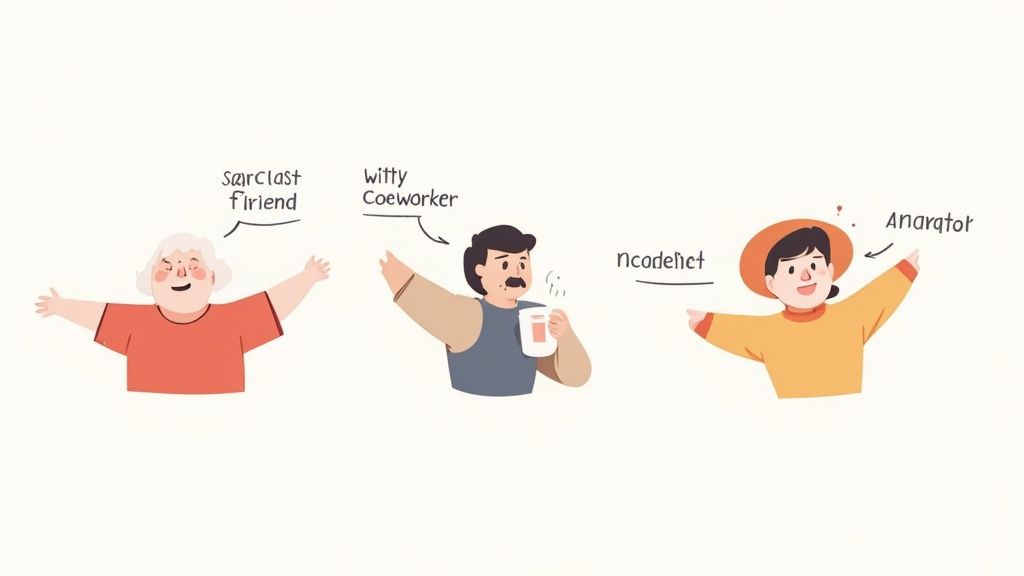
Give Your Brand a Personality
Let's get weird for a second. If your brand was a person, who would they be? This little exercise is the fastest way to figure out how you should sound. Is your brand a mom who survives on coffee and chaos, a dad armed with a full arsenal of bad jokes, or a college student who’s just… completely over it?
Once you have that "person" in mind, their voice becomes crystal clear. Think about a tee that says "Tired as a Mother." The description sounds totally different coming from a snarky best friend versus a wholesome, cheerful pal.
One might say, "The official uniform for surviving toddler tantrums and microwaved coffee." The other might go with, "A super-soft tee for those busy mom-on-the-go days!" Both are fine, but only one probably feels right for your shop.
Here are a few questions to get the ball rolling:
- What’s their sense of humor? Is it dry and sarcastic, goofy and punny, dark and edgy, or light and observational?
- What pop culture do they reference? Are they quoting The Office for the tenth time or spitting out the latest TikTok sound?
- Who do they hang out with? This is a sneaky way to define your target audience. Are they talking to other exhausted parents, fellow nerds, or cynical millennials?
Answering these helps you build a character. And once you have that character, writing in their voice becomes second nature. It’s the difference between a generic greeting and your best friend sliding into your DMs with, “Dude, you will not believe what happened.”
Create a Simple Voice Guide
Okay, you’ve brainstormed your brand’s persona. Don't just let it live in your head—write it down.
Seriously. You don’t need a 50-page corporate brand book. A simple one-page guide is perfect for keeping your tone consistent across all your product descriptions, social media posts, and emails.
This makes sure that whether you're writing the copy or you hire a freelancer, everything sounds like it’s coming from the same person. It's how you build a brand that feels reliable and familiar, like an old friend.
Pro Tip: Your voice guide is your brand's North Star. It's not just a set of rules; it's a gut check for who you are and who you're talking to. Consistency builds trust, and trust builds sales.
Your voice guide could look something as simple as this:
Our Voice Is...
- Witty & Sarcastic: We find the humor in everyday chaos. We're the friend who texts back with the perfect GIF.
- Relatable & Casual: We talk like a real person, not a robot. Phrases like "let's be real" and "we get it" are our jam.
- A Little Cheeky: We're not afraid to poke fun at ourselves (or you), but we're never mean-spirited.
Our Voice Is Not...
- Corporate or Stuffy: We avoid jargon and formal language. If it sounds like it belongs in a business email, we delete it.
- Overly Enthusiastic: We’re cool and confident, not hyper. No excessive exclamation points!!!
- Generic: We don't say "high-quality." We say "so soft you'll want to sleep in it."
This simple framework acts as a filter for every word you write. It helps you craft descriptions for all your novelty tees and relatable shirts with confidence, ensuring each one hits that perfect comedic note. This is how you stop selling funny t-shirts and start building a community.
Anatomy of a High-Converting Description
Alright, let's get into the good stuff. A killer product description is more than just a funny one-liner slapped on a page. It's a carefully crafted machine designed to do two things: make someone laugh and make them click "add to cart."
Think of it like a really good joke. It needs a setup, a punchline, and perfect timing. A great description has a similar structure, guiding your customer from a casual scroll to an enthusiastic purchase. We’re going to dissect this beast piece by piece.
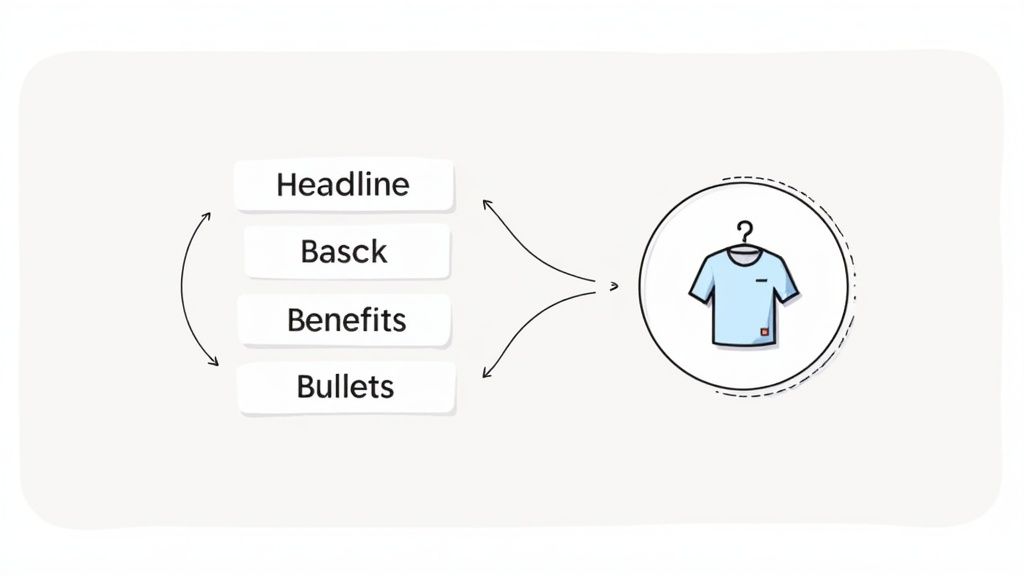
Nail the Scroll-Stopping Headline
This is your first impression, your pickup line. It’s your one shot to stop someone from endlessly scrolling through their feed. A headline like "Funny T-Shirt" is a total snoozefest. It does nothing. You need something that sparks curiosity and hints at the joke.
Instead of just naming the product, give it a personality.
- Before: "Coffee Slogan Tee"
- After: "The Official Uniform for Surviving Mondays"
See the difference? The second one tells a story. It’s instantly relatable. It makes your customer think, "Hey, that's me," and that’s exactly what you want.
Hook Them With a Punchy Opening
You've stopped the scroll with your headline; now you have about three seconds to keep their attention. Your opening paragraph needs to be short, punchy, and hit them right in the feels. This is where you set the scene for the joke on the shirt.
For a "Tired as a Mother" shirt, don't just say it's for moms. Paint the picture. "For the woman who runs on lukewarm coffee and the sheer will to find a matching pair of socks. This isn't just a shirt; it's a badge of honor for the sleep-deprived."
It’s not about the shirt; it’s about the feeling.
Features vs. Benefits: The Main Event
This is probably the most critical part of writing a description that sells, so listen up. Nobody—and I mean nobody—buys features. They buy benefits.
Let’s be real, your customer doesn’t care that our shirts are made with a specific cotton blend. They care that it feels ridiculously soft against their skin after a long, chaotic day. They care that it won’t shrink into a toddler-sized crop top after one wash.
Feature: "Made from a premium tri-blend of polyester, cotton, and rayon."
Benefit: "Feels like your favorite worn-in tee from day one, minus the questionable stains from college."
Always translate the "what" (the feature) into the "so what" (the benefit). That’s how you sell an experience, not just a piece of fabric.
Use Bullets for the Quick Scan
People have the attention span of a goldfish. After you've hooked them with a great story, give them the fast facts in an easy-to-scan format. Bullet points are your best friend here. They're perfect for the quick details that seal the deal.
- So Ridiculously Soft: Made with a premium cotton blend that feels like a weekend hug.
- Won’t Shrink Into a Belly Shirt: Pre-shrunk for a fit that stays true, wash after wash.
- Vibrant, Won't-Fade Print: Our colors stay bright, just like your personality. Thanks to our top-notch printing process, this tee is built to last.
This format gives scanners everything they need to know without having to read a novel. It’s the perfect blend of storytelling and straight talk. By building your descriptions with these pieces—a killer headline, a punchy opening, benefit-driven copy, and scannable bullets—you create a seamless path from "just looking" to "just bought."
Weaving SEO Keywords into Your Copy
Let's talk about the beast in the room: SEO. Just hearing the acronym can make your eyes glaze over, but it's the secret sauce that helps shoppers find your hilarious tees on Google. The real trick is learning how to write product descriptions that make search engines happy without sounding like a robot who just swallowed a dictionary.
You’ve probably seen "keyword stuffing" in the wild. It’s that cringey, desperate-sounding copy that reads, "Buy our funny t-shirt, a hilarious t-shirt for funny people who like funny t-shirts." Yeah, no. That’s a one-way ticket to killing your brand’s vibe.
The goal is to sprinkle your keywords in so naturally they just feel like part of the conversation. Think of it like salting your food — a little bit makes everything better, but too much ruins the whole meal. You want to enhance your witty prose, not overpower it.
Finding Your Golden Keywords
Before you can start weaving, you need to know what threads you're working with. Your main, or primary, keyword is the big one, like "funny t-shirts." But the real magic is in the long-tail keywords. These are the longer, more specific phrases people are actually typing into Google when they’re ready to buy.
Get inside your customer's head. Are they hunting for "mom life shirts" because they're knee-deep in toddler chaos? Or maybe they need a "sarcastic dad shirt" for Father's Day. These phrases are pure gold because they’re less competitive and attract people who know exactly what they want.
Here’s a quick-and-dirty way to find them:
- Google Autocomplete: Just start typing "shirts for moms who..." into the search bar and see what Google thinks you're going to say. It's usually spot-on.
- "People Also Ask" Box: Search for a broad term and scroll down a bit. This section is a goldmine of real questions your customers are asking.
- Competitor Recon: Pop over to your rivals' product pages. What words are they using in their titles and descriptions? A little friendly snooping goes a long way.
This isn’t about hoarding a million keywords. It's about finding the right ones that connect directly to your brand of humor.
Where to Place Keywords for Maximum Impact
Alright, you’ve got your list of golden phrases. Now, where the heck do you put them? Tossing them in randomly won't do you any favors. You have to be strategic.
The best SEO feels invisible to the customer but is crystal clear to Google. It's a supporting actor, not the star of the show. Your humor and brand voice should always take center stage.
Think about the most important real estate on your product page. These are the spots where both customers and search engines look first to figure out what you’re selling.
Here's your keyword placement checklist:
- Product Title (H1): This is your big, bold headline. Make it fun, but slip your main keyword in there. Instead of "Awesome Tee," go with "The 'Caffeine & Chaos' Tee | A Funny Mom Life Shirt."
- The First Sentence: Your opening line is prime real estate. Weave a keyword in right away to tell the reader (and Google) they're in the right place.
- Bullet Points: As you list out the awesome features of your shirt, sprinkle in a keyword or two naturally. For example, "The Ultimate Relatable Shirt: So soft, you'll forget you're wearing adult clothes."
- Image Alt Text: This is the hidden text that describes your image if it can't load. It’s the perfect, invisible spot to drop a descriptive keyword phrase like, "Woman laughing while wearing a funny novelty tee."
By putting your keywords in these key spots, you’re sending clear signals to search engines about what your product is, all while keeping your copy fun, fresh, and totally on-brand. No clunky robot-speak required.
Copywriting Formulas to Spark Creativity
Staring at a blank screen is the absolute worst. It’s that awful moment when your brain clocks out for an early lunch, leaving you with nothing but the blinking cursor of doom. Don’t sweat it. You don’t need to be a literary genius to write a killer description; you just need a few cheat codes.
Think of copywriting formulas as your creative toolkit—proven structures you can pull from whenever you feel stuck. They’re like training wheels for your wit, giving you a solid starting point so you can focus on injecting your brand's unique humor.
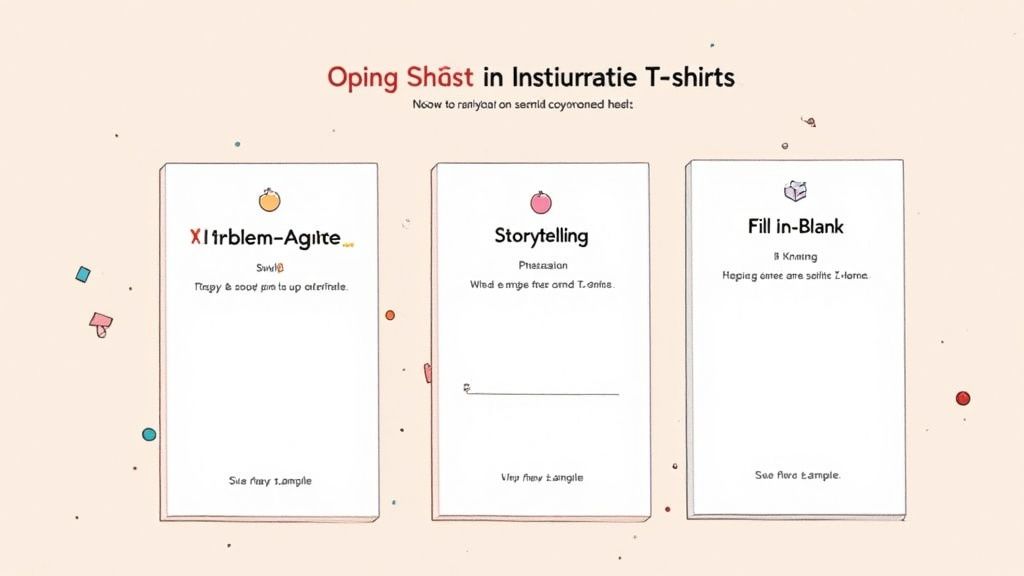
The Problem-Agitate-Solve (PAS) Formula
This one is a classic for a reason: it just works. You start by calling out a pain point your customer deals with, poke the bruise a little to make it real, and then present your awesome t-shirt as the perfect solution. It’s simple, effective, and hits home every time.
- Problem: Mondays are the actual worst. The alarm goes off, and the weekend feels like a distant, beautiful dream.
- Agitate: You have to put on real pants, deal with that coworker who heats up fish in the microwave, and sit through meetings that absolutely could have been an email. The Sunday Scaries were real, and now the Monday Misery has set in.
- Solve: This shirt won't do your TPS reports for you, but it will serve as a silent protest against adulting. It’s the softest, comfiest armor you can wear to battle the start of the week.
This formula turns a simple novelty tee into a necessary survival tool. It shows you get your customer’s struggle, which is the fastest way to build a real connection.
The Storytelling Formula
People don't just buy products; they buy stories. This formula is all about turning your t-shirt into a character or setting a scene. You’re not selling a piece of fabric; you’re selling an identity, an inside joke, or a hilarious moment.
Give the shirt a backstory. Who wears it? Where do they wear it? What kind of chaos are they getting into?
T-Shirt Example: "The 'I Run on Coffee and Sarcasm' Tee"
Story: Meet your new best friend. It’s the shirt that understands your soul-deep need for caffeine before any human interaction. It’s been there for 7 a.m. school drop-offs, survived endless Zoom calls, and has never once judged you for ordering a second pastry. This tee doesn’t just have your back; it has your snarky comebacks covered, too.
This approach makes your products stick. When you sell a story, you're not just moving inventory—you're creating a legend. If you're brainstorming more ways to bring your ideas to life, check out our guide on making your own graphic tees.
Before-After-Bridge (BAB) Formula
The BAB formula is another simple yet powerful framework. You paint a picture of your customer's world before they have your shirt, describe how much better life is after they have it, and then show how your product is the bridge that gets them there.
- Before: Your closet is a sea of boring, plain shirts that say absolutely nothing about your sparkling personality.
- After: You’re walking around town, and your shirt is doing all the talking for you. Strangers are high-fiving you, baristas are giving you free espresso shots, and your friends are all asking where you got that amazing tee.
- Bridge: This shirt is your ticket to a more hilarious wardrobe. It’s the conversation starter, the mood lifter, and the easiest way to tell the world you’ve got a killer sense of humor.
Sometimes, all you need is a simple framework to get the words flowing. Here are a few of our favorites boiled down into a quick-reference table.
Quick-Start Copywriting Formulas
| Formula | How It Works | T-Shirt Example |
|---|---|---|
| PAS (Problem-Agitate-Solve) | Identify a pain point, make it worse, then offer your tee as the solution. | Problem: Family gatherings are awkward. Agitate: Your uncle is asking about your love life again. Solve: Wear our "I'm Just Here for the Food" tee and deflect with humor. |
| BAB (Before-After-Bridge) | Show life before the shirt, life after the shirt, and how the shirt is the bridge. | Before: You're quiet and blend in. After: You're the life of the party. Bridge: This "Warning: May Spontaneously Talk About Cats" shirt is the perfect icebreaker. |
| Storytelling | Create a persona or a mini-story around the t-shirt. | "This shirt has survived three toddler tantrums and a spaghetti incident. It's not just cotton; it's a battle-tested badge of honor for parents." |
| AIDA (Attention-Interest-Desire-Action) | Grab attention, build interest and desire, and then tell them what to do next. | "Tired of boring clothes? Our 'Feast Mode' tee is made from ultra-soft cotton that feels as good as Thanksgiving dinner tastes. Grab yours and get ready to eat." |
These formulas aren't strict rules—they're springboards. Mix them, match them, and tweak them until they sound like you. The goal is to find a structure that lets your brand's personality shine.
Find Your New Favorite Shirt
Okay, you’re officially a copywriting pro. You know the secret sauce to writing product descriptions that are witty, engaging, and ready to sell.
But let’s be real—even the most brilliant copy needs an amazing product to back it up. That’s where we come in.
A killer description is half the battle, but a ridiculously soft, high-quality shirt is what turns a one-time buyer into a loyal fan. Our tees are designed to feel like a hug from a cloud—the kind of comfort you’ll refuse to take off all weekend. We obsess over premium materials because we know you can feel the difference. For a deeper dive, learn more about why soft, high-quality cotton shirts are the real MVP of your closet.
More Than Just a Funny Tee
We get it. The little things matter. That’s why we’ve dialed in the details that make shopping with us a total no-brainer.
- Always-Free Shipping: Let’s be honest, seeing a shipping fee at checkout is the ultimate buzzkill. We nuked it. Forever.
- Fresh Laughs, Every Week: Our creative team is constantly dreaming up new designs, which means there’s always a fresh, hilarious reason to come back and find a new favorite.
- Quality You Can Feel: From mom life shirts to sarcastic novelty tees, every single item is crafted for comfort and built to last through countless washes and wears.
You’ve earned a reward for all this learning. It's time to experience the quality and humor you’ve been reading about.
Go on, you deserve it. Shop the Laughs.
Your Top Product Description Questions, Answered
Alright, so you're ready to write copy that actually sells. After diving into the nitty-gritty, a few questions usually bubble up. Let's knock them out so you can get back to what you do best: selling awesome shirts.
How Long Should My Product Descriptions Be?
There’s no magic number, but the sweet spot is "short and punchy." People are scrolling, probably on their phones while pretending to work. They don't have time for a novel.
Think of it like a good joke—get to the punchline fast. Here’s a simple formula that works every time:
- A killer headline that grabs attention.
- A 2-3 sentence paragraph that sets the scene or tells a mini-story.
- 3-5 bullet points covering the essentials (fit, fabric, care tips).
This structure gives the skimmers what they need while still giving the readers a taste of your brand's personality. Keep it tight, funny, and focused.
Can I Just Use AI to Write Everything?
You can, but treat AI like your brainstorming buddy, not your head writer. It's a fantastic tool for getting past writer's block or spitting out a first draft when the coffee hasn't kicked in yet.
But here’s the thing: AI doesn’t get your brand’s inside jokes. It can’t replicate that specific, sarcastic flair that makes your funny t-shirts feel like your t-shirts. It often sounds a little… robotic.
Use AI to get the engine started, then grab the steering wheel. The best descriptions mix AI's speed with your genuine human wit. At the end of the day, your customers are buying a piece of your brand, not something generated by a machine.
What's the Single Biggest Mistake to Avoid?
Being boring. Seriously. The absolute worst thing you can do is just list features. No one is searching for a “100% cotton tee.” They’re looking for “the softest shirt they’ll want to live in all weekend.” They want to know how it's going to make them feel, how it's going to make their friends laugh.
Another classic mistake is sounding too buttoned-up or corporate. You're selling relatable shirts, not insurance. A casual, even cheeky, tone is what builds that "I get you" connection with your audience. And while you're at it, make sure your awesome designs actually last. If you need some pointers, we've got a whole guide on how to wash graphic tees to keep them looking brand new.
At Laugh Riot Tee’s, we're all about blending killer copy with even better products. Our shirts are ridiculously soft, our designs are always fresh, and our shipping is always on the house.