

How to Build a Clothing Brand from Your Couch (Without Losing Your Mind)
Got a killer t-shirt idea scrawled on a napkin from last night’s pizza binge? Good. Forget the fancy business degree for a minute. Building a clothing brand is less about soul-crushing spreadsheets and more about having a unique voice and a whole lot of grit.
Let’s be real, you’re here because you think your jokes are better than the ones on those generic, soulless tees at the mall. And you’re probably right.
This guide is your no-fluff roadmap. We're going from that hilarious one-liner on a napkin to the sweet, sweet sound of your first Shopify "cha-ching."
Step 1: Your T-Shirt Idea Is Actually Genius (Probably)
Let's get one thing straight. That idea you have for a "mom life shirt" that perfectly nails the chaos of a Tuesday morning? Or that sarcastic cat-lover tee that just screams, "I've accepted my fate"? It’s brilliant. Don't let anyone tell you otherwise.
The world doesn't need another boring corporate logo tee. It needs your weird, wonderful, and slightly unhinged sense of humor.
Starting a clothing brand from your couch sounds like a pipe dream, but it's more doable now than ever. You’re not just selling cotton; you're selling a personality, a punchline, and a sense of belonging for people who get it.
First Things First: The Foundation
Before you dive headfirst into designing and printing, you need a game plan. This isn't the boring part; it's the "make sure you actually make money" part. Think of it as the pre-game huddle, but with more coffee and less rah-rah.
Let’s get your foundation solid before you spend a dime.
Your Brand's Foundation: The No-BS Checklist
| Key Area | Why It Matters (In Plain English) | Your First Action Item |
|---|---|---|
| Find Your Niche | You can't be everything to everyone. Trying is a fast track to being nothing to anyone. It’s like trying to be a vegan butcher. Doesn’t work. | Pick a specific group. "Dog dads," "plant moms," or "people who think coffee is a food group." Get specific. |
| Define Your Vibe | Is your brand snarky? Wholesome? A little weird? This dictates your designs, your marketing, and the fans you'll attract. | Write down 3-5 words that describe your brand's personality (e.g., Sarcastic, Witty, Relatable, Exhausted). |
| Do Sneaky Research | See what other funny t-shirt brands are doing. Find the jokes they're missing, the audiences they're ignoring. Your genius lies in their blind spots. | Spend 30 minutes on Etsy and Instagram. Note 3 brands you like and 3 you don't. Why? |
Nailing these down first makes every single decision that follows about a million times easier. We get it, planning is a drag, but trust us on this one.
Let’s be real: you're entering a massive playground. The apparel industry is huge, with the women's apparel market alone projected to cross $1 trillion by 2027. This means there's plenty of room for your unique voice, especially since online retail is growing and expected to capture nearly 25% of all apparel sales by 2025. You can discover more insights about the global apparel industry and see just how big the opportunity is.
Building a brand is about creating a world people want to be a part of. It's about making someone laugh so hard they have to show their friend, who then shows their friend. That’s how you go from a funny idea to a thriving business.
Step 2: Bringing Your Designs to Life
Time for the best part—taking those hilarious one-liners bouncing around your brain and turning them into actual, wearable comedy. This is where your brand stops being just a cool idea and starts developing a real personality.
A killer brand is way more than a slick logo. It's the whole vibe—the name, the colors, the voice—that makes someone stumble across your shirt and think, "Finally, someone gets me."
Think of your brand identity as a character. If your brand walked into a party, who would it be? The smart-ass in the corner, the loud storyteller everyone’s gathered around, or the quiet one who drops devastatingly witty one-liners when you least expect it?
Turning Inside Jokes Into Wearable Gold
Got your brand’s personality locked in? Perfect. Now, let’s get those first few t-shirt designs off the ground. Your mission is to create stuff that’s so relatable, people feel compelled to share it. The best funny t-shirts are the ones that make someone grab their friend's arm and say, "Dude, you have to see this."
Start by just brain-dumping ideas. No filter. What are the inside jokes your ideal customer would get in a heartbeat? What's a universal frustration you can spin into a punchline? Your first designs don't need to be artistic masterpieces. They just need to be funny and true to your brand.
Pro Tip: Seriously, don't overthink this. Some of the most legendary novelty tees are absurdly simple. The magic is usually in the cleverness of the words, not the complexity of the illustration. Keep it simple, genius.
If you want to get into the nitty-gritty of the design process, we've got a whole guide on making your own graphic tees that breaks it all down.
What If I Can’t Even Draw a Stick Figure?
So you’re not a graphic designer. Join the club—most of us aren't! The fantastic news is you don’t have to be. The world is full of talented freelance designers on sites like Fiverr or Upwork who can transform your back-of-the-napkin sketches into print-ready files.
Here’s how to work with a designer without pulling your hair out:
- Write a Crystal-Clear Brief: The more detail you give, the better the result. Explain your brand's personality, send them examples of designs you love (and hate), and lay out your concept clearly. A solid brief saves everyone from endless revisions.
- Demand the Right File Types: This part is non-negotiable. You need a high-resolution vector file (that means an .AI, .EPS, or .SVG). A blurry screenshot from your phone won’t cut it, and your printer will politely (or not so politely) tell you to try again.
- Give Feedback That Actually Helps: Instead of just saying, “I don’t like it,” try something like, “Could we make the font a bit bolder and shift the whole graphic up an inch?” Specific, actionable feedback gets you to the finish line faster.
The Not-So-Scary Legal Stuff
Alright, a quick and important note on protecting your work. Once you've landed on a brilliant brand name and a logo you love, you'll want to make sure it stays yours. A trademark is what prevents another company from popping up with a confusingly similar name and riding your coattails.
You don't need a law degree for this. A simple search on the US Patent and Trademark Office (USPTO) website can tell you if your name is already taken. It’s a five-minute task that can save you from a world of hurt—and a dreaded "cease and desist" letter—later on. Think of it as putting a lock on your vault of brilliant jokes.
Step 3: Choosing Your Suppliers and Printing Methods
Okay, your designs are ready. They’re hilarious, brilliant, and just sitting in a folder on your desktop, waiting to become wearable art. Now for the slightly less glamorous but incredibly important part: turning those digital files into actual, physical shirts that people will love to wear.
Let’s be real. The quality of your blank tees is what separates a one-time novelty gift from a brand people rave about. You want customers opening their package and thinking, “Heck yes, this is my new favorite shirt,” not, “Well, this is going straight into the car-washing-rag pile.”
Getting this right is how you build a loyal following and avoid a tsunami of angry customer service emails.
Print-on-Demand vs. Bulk Inventory
First things first, you have to decide how you're going to get these shirts made. You've got two main paths, and your choice will have a huge impact on your startup costs, your workload, and honestly, your sanity.
Print-on-Demand (POD): The Low-Risk Lifesaver
With POD, you sync your online store with a third-party service like Printful or Printify. When a customer buys a shirt, the POD company prints it, packs it, and ships it directly to them. You don't touch a thing. It's magic.
- The upside? Zero upfront inventory costs. You don’t pay for a single shirt until you’ve already made a sale. This is a massive win when you’re just starting out.
- The downside? Lower profit margins. Since you’re paying for a one-off printing and fulfillment service, your cost per item is higher, so you keep less cash from each sale.
Buying in Bulk: The Go-Big-or-Go-Home Approach
This is the old-school route. You find a local screen printer, order a big batch of your "Tired as a Mother" design (say, 50 shirts), and store them in your garage. You are now the master of your inventory.
- The upside? Way better profit margins. Buying in bulk drastically lowers your cost per shirt, which is great for your bottom line.
- The downside? High upfront cost and risk. You have to guess which designs and sizes will sell. If you guess wrong, you’re stuck with boxes of unsold tees collecting dust.
My Two Cents: If you’re just starting out, Print-on-Demand is your best friend. It lets you test dozens of funny t-shirt ideas with zero financial risk. Once you’ve figured out which designs are clear winners, then you can think about graduating to bulk orders to boost your profits.
Print-on-Demand vs Bulk Inventory: A Showdown
To make the choice even clearer, here's a head-to-head comparison to help you choose the right production model for your new clothing brand.
| Factor | Print-on-Demand (POD) | Bulk Inventory |
|---|---|---|
| Upfront Cost | $0 | High (can be thousands of dollars) |
| Profit Margin | Lower (typically 15-25% per shirt) | Higher (can be 50-70% or more) |
| Risk | Very Low | High (risk of unsold stock) |
| Inventory | None - you hold zero stock | You manage, store, and pack everything |
| Product Range | Massive (test unlimited designs/colors) | Limited (you have to buy what you sell) |
| Fulfillment | Handled for you by the POD company | You handle all packing and shipping |
| Best For... | New brands, testing ideas, low-budget startups | Established brands with proven bestsellers |
Ultimately, there's no single "right" answer. POD is fantastic for getting started, while bulk inventory is the goal for scaling your most popular designs.
Picking Your Printing Poison
Next up: how does the ink actually get onto the fabric? The two heavyweights in the custom tee world are Direct-to-Garment (DTG) and screen printing. Each has its place.
Direct-to-Garment (DTG) is basically a giant, fancy inkjet printer for clothes. It’s perfect for detailed, multi-color designs. This is what most POD services use, since it's ideal for printing just one shirt at a time. Want to go deeper? We have a whole article explaining what Direct-to-Garment printing is.
Screen Printing, on the other hand, involves pushing ink through a mesh screen onto the fabric, one color at a time. This method is the go-to for bulk orders. Once the screens are created, it's super fast and cost-effective for large runs. The prints are also incredibly durable and have that classic, vibrant feel.
This handy infographic helps visualize the decision-making process for creating your designs, whether you're going the DIY route or hiring a pro.
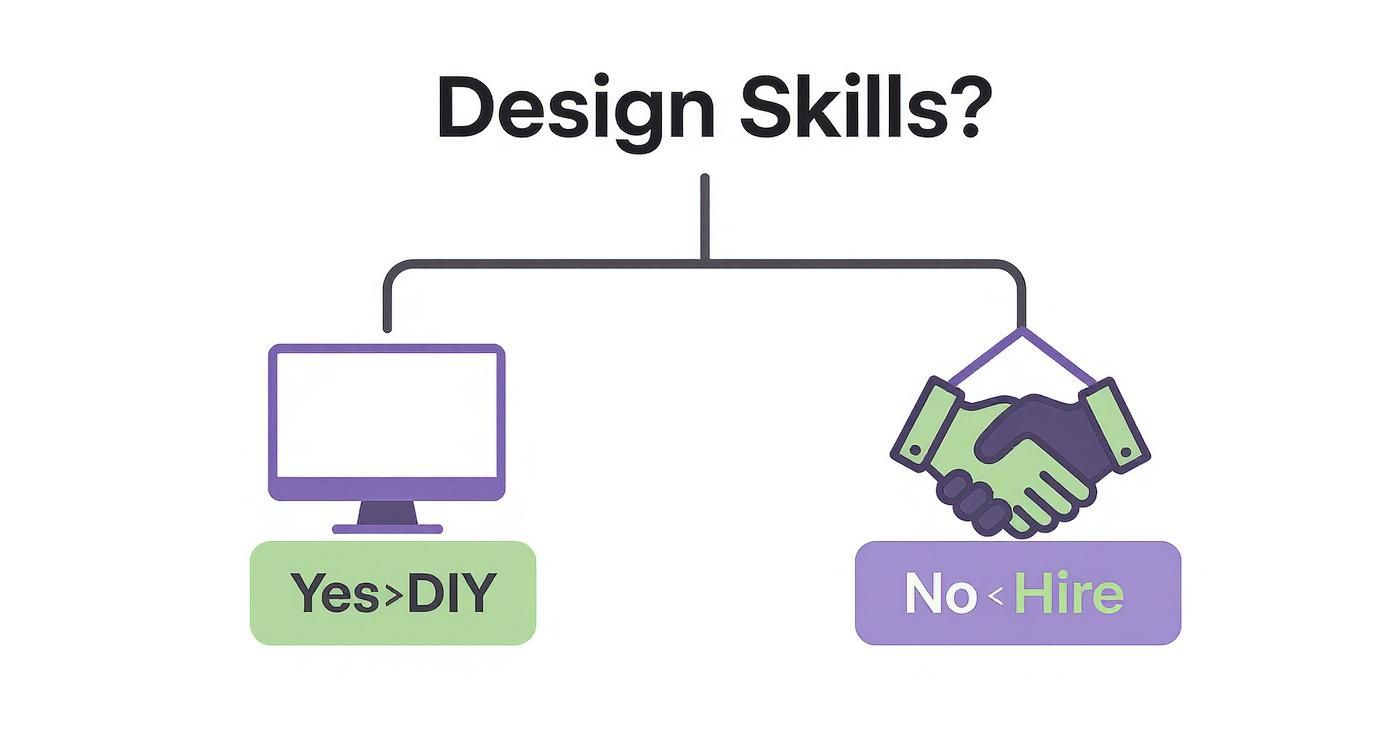
As you can see, your production choices are tied directly to your creative process, so mapping out your path early on saves a lot of headaches down the road.
How to Vet Suppliers Like a Pro
Whether you're choosing a POD partner or a local screen printer, you have to do your homework. A bad supplier can sink your brand before it even gets a chance to float.
Here's what you need to ask any potential partner:
- Can I get samples? Never, ever commit to a supplier without feeling the product yourself. Order a sample. Wear it. Wash it. Does it shrink into a doll-sized shirt? Does it feel like sandpaper? This is non-negotiable.
- What are your average turnaround times? How long does it take from the moment an order is placed to when it actually ships? Customers expect things fast. "Ships in 2-3 weeks" won't cut it.
- What are your quality standards for printing? Ask to see examples of their work, especially designs with fine lines or vibrant colors. You're looking for crisp details, not blurry messes.
Your supplier is your partner in building trust, so choose wisely.
Step 4: Building Your Online Storefront
https://www.youtube.com/embed/FyPBXoQxrIw
Alright, you’ve got designs that could make a statue chuckle and a supplier lined up. Now you just need a place to live online—a digital home where people can throw money at you for your genius.
Let’s be real, your online store is your brand’s headquarters, its main stage, and its fitting room all rolled into one. No pressure, right? Luckily, setting one up is easier than assembling IKEA furniture (and way more rewarding).
Platforms like Shopify are basically built for people like us—creative types who’d rather be thinking up the next viral t-shirt slogan than wrestling with code.
Picking Your Platform And Theme
Shopify is the undisputed king for a reason: it's user-friendly, scalable, and has an app for pretty much everything. It’s the reliable best friend who always has snacks and a phone charger.
Once you’re set up, it's time to pick a theme. This is your store’s outfit. Your theme needs to match your brand's personality. If your brand is bold and sarcastic, a minimalist, delicate theme is going to feel like a whisper in a rock concert. Look for themes with big, punchy image sections and clean, easy-to-read fonts that let your designs do the talking.
Key Takeaway: Your online store isn't just a digital cash register. It’s the entire customer experience. A clunky, confusing website is the online equivalent of a store with flickering lights and a weird smell—people will just leave.
Product Photos And Descriptions That Actually Sell
Now for the main event: your product pages. This is where you convince someone that they don't just want your "I Need More Sleep" shirt; they need it to survive another Monday.
Let's talk visuals. High-quality product photos are non-negotiable. Don't settle for the generic, flat-lay mockups everyone else uses. Invest a few bucks in some lifestyle mockups that show your shirt on actual humans who look like they’re having a good time. A good mockup helps customers visualize themselves wearing your relatable shirt while living their best, most caffeinated life.
Next up, the product description. This is your sales pitch. Please, for the love of all things funny, do not just write: "White t-shirt. 100% cotton." That tells them nothing. Your description needs to sell the joke. Need help? We have a whole guide on how to write product descriptions that slay.
Here’s how to do it right:
- Sell the Feeling: Why is this shirt a must-have? Does it capture the essence of being a tired parent? Is it the perfect gift for a sarcastic best friend?
- Tell a Mini-Story: Give them a scenario. "Perfect for your next Zoom meeting where you need to look professional from the waist up but feel incredibly petty from the waist down."
- Include the Boring Stuff: After you've hooked them with humor, add the practical details: soft, high-quality fabric, unisex sizing, and care instructions.
The Checkout And Shipping Dance
Finally, make it easy for people to give you their money. Run a test order to make sure your checkout process is smooth and painless. Nothing kills a sale faster than a confusing, multi-step checkout that asks for their childhood pet’s name.
Be upfront about shipping costs and times. If you can swing it, offering free shipping is a massive psychological win for customers. We do it at Laugh Riot Tee’s because, honestly, shipping fees are the worst kind of joke.
Step 5: Marketing Your Brand Without a Massive Budget

You did it. The store is live, the designs are brilliant, and you've officially got a clothing brand. Now for the fun part: making sure people actually see it.
Let’s be real, you probably don’t have a Hollywood-sized marketing budget lying around. The good news? You don’t need one. Building a tribe of loyal fans is less about throwing money at ads and more about being clever, consistent, and genuinely entertaining.
Find Your Digital Playground
Forget trying to be everywhere at once—that's a one-way ticket to burnout. You need to hang out where your people are. For a brand built on funny t-shirts and relatable humor, your best friends are going to be visually-driven platforms like Instagram and TikTok.
These platforms are practically built for sharing funny, bite-sized content. A hilarious Reel or a perfectly timed meme can get more eyes on your brand in 24 hours than a billboard ever could, and it costs exactly zero dollars.
Content That's More Than Just a Sales Pitch
Okay, this is critical. If your social media feed is just a constant stream of "BUY MY SHIRT," you're going to lose followers faster than a toddler loses their socks. People don't follow brands; they follow personalities. Your content needs to entertain first and sell second.
The rule of thumb here is the 80/20 principle. 80% of your content should be pure entertainment. Only 20% should be a direct pitch to buy your awesome novelty tees. This keeps your audience hooked and makes them way more receptive when you do ask for the sale.
Here are some content ideas that go way beyond the sales pitch:
- Behind-the-Scenes Shenanigans: Show your creative process, even the messy parts. A funny poll asking which terrible joke should become a shirt makes people feel included.
- User-Generated Content (UGC): When a customer posts a photo rocking one of your shirts, celebrate it! Reshare their post (with permission, of course) and make them feel like a hero. This is social proof gold.
- Relatable Memes and Reels: Create content that hits on the same pain points and inside jokes as your shirts. If you sell mom life shirts, share hilarious Reels about the chaos of school drop-off. You're not just selling a product; you're part of the conversation.
The Magic of Micro-Influencers
When you hear "influencer marketing," you might picture celebrities demanding a six-figure paycheck. Forget that. The real magic for new brands lies with micro-influencers. These are creators with smaller, but hyper-engaged, followings—think 5,000 to 50,000 followers.
Their audience trusts their recommendations because they feel authentic, not like a giant, sponsored ad. Find creators whose sense of humor and audience perfectly align with your brand. Reach out with a friendly, personal message (no copy-paste templates!) and offer to send them a few of your best shirts. A genuine partnership with the right micro-influencer can be a total game-changer.
Don't Sleep on Email Marketing
Social media is like renting an apartment—you're at the mercy of the algorithm landlord. Your email list, on the other hand, is property you own. It’s a direct line to your most loyal fans.
Start building your list from day one with a simple pop-up on your website offering a small discount (like 10% off) in exchange for their email. A simple weekly or bi-weekly email can work wonders. Send them exclusive early access to new designs, funny stories, and special discounts. This makes your email list feel like a VIP club, not a marketing blast.
So, You're Ready to Launch (For Real This Time)
Whew. That was a lot, I know. But look at you now—you've got the complete blueprint for building a clothing brand, from locking down a niche to designing killer shirts and actually getting them to people who appreciate a good laugh.
Building a brand is definitely a marathon, not a sprint. But trust me, the payoff comes when you see someone out in the world wearing a joke that started in your head. That's the moment we live for at Laugh Riot Tees.
Speaking of which, we’re obsessed with creating super-soft, high-quality shirts that feel as good as they look. That’s why we’re always dropping new designs weekly—because humor never sleeps. And because we think shipping fees are a total joke (and not the funny kind), we offer free shipping on all orders. We get it.
You’ve earned a reward for all this reading. Go on, treat yourself.
Shop the Laughs
Let’s be real, you’ve earned it. After all that hard work learning the ropes, it’s time for a little retail therapy. Grab a shirt that makes you smile.
Got Questions? We’ve Got Answers.
Alright, let's tackle those nagging questions bouncing around in your head. Starting a brand can feel like you've been handed a map where all the important bits are written in wingdings. It’s confusing.
Here are the straight-up, no-fluff answers to the big questions everyone asks.
Seriously, How Much Cash Do I Need to Start?
This is the big one, isn't it? The real answer is: it depends on how you play it.
If you go with Print-on-Demand (POD), your starting costs are laughably low. You're looking at a Shopify subscription (which is about $39/month) and maybe a few bucks for a domain name that sounds cool. That's it. You don't pay for a shirt until a customer has already paid you.
Now, if you want to buy your inventory in bulk, that's a different story. You'll need a few thousand dollars upfront. For 99% of people just starting out, POD is the smartest, safest way to get the ball rolling.
Do I Need a Business License From Day One?
Ugh, legal paperwork. Fun, right? While the rules change depending on where you live, it’s a smart move to look into getting a business license or setting yourself up as a sole proprietorship or LLC early on.
It feels like a pain, but this is what makes your business legit. It lets you legally collect sales tax and, more importantly, it keeps your personal money separate from your business money. A quick search for your local small business administration office is the best place to start. Just do it.
Can I Put My Own Brand Label on Wholesale T-Shirts?
You absolutely can! This is called white labeling or private labeling, and it’s how the pros do it. You buy high-quality blank tees from a supplier and then have your own custom neck tags printed inside with your logo and sizing.
It’s a simple trick that instantly makes your products feel more premium and professional. It’s a small detail that transforms a generic tee into one of your signature relatable shirts.
At Laugh Riot Tees, we’ve asked (and answered) all of these questions ourselves to get our brand off the ground. Now that you’ve got the intel, go build something awesome. Or, you know, just buy something awesome from us.