

How to Find Your Niche Market Without Losing Your Mind (or Your Money)
Trying to find your niche market is a lot like dating. You could stand on a table in a crowded restaurant and yell, "I'm a catch!" hoping someone, anyone, notices. Or you could find that one weirdo in the corner who also thinks pineapple on pizza is a gift from the heavens. One of these strategies usually works out better.
It’s about trading a massive, uninterested crowd for a smaller, passionate group that actually gets your jokes. For a funny t-shirt brand like us, it means focusing on a specific audience—like sleep-deprived moms or dads armed with legendary bad jokes—so your marketing actually lands and you build a real community. Let's get into it.
Why Selling to Everyone Sells to No One
Let's be real. Trying to sell a funny t-shirt to every single person on the planet is like trying to teach a cat to do your taxes. It's a spectacular waste of time, and you’ll probably just end up getting scratched.
This is the exact moment you need to figure out how to find your niche market. It’s the secret sauce that separates the shops that fizzle out from the brands that blow up.
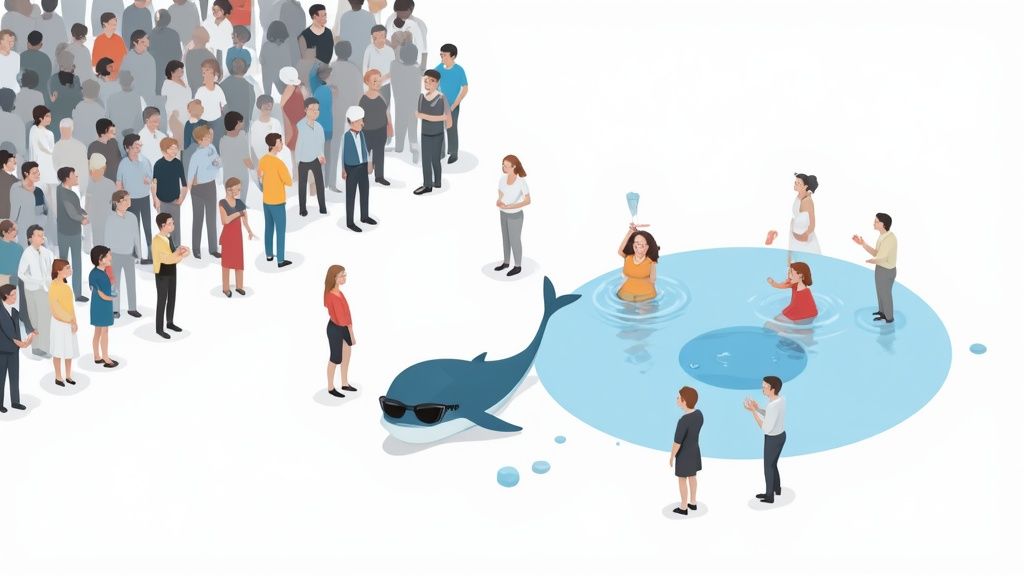
Think of it this way: when you target "everyone," your message becomes so generic it’s basically background noise. You’re just another tiny fish in an endless ocean of online stores, all screaming for attention.
But when you find your niche? You become the cool, sunglasses-wearing whale in a really profitable pond.
The Power of a Focused Audience
Instead of shouting into the void, you get to have an actual conversation with people who are already on your wavelength. This focused approach makes everything a million times easier.
- Your Marketing Becomes Effortless. You know exactly where your people hang out online, what inside jokes make them laugh, and what problems keep them up at night. Crafting ads and social media posts suddenly feels like you're just talking to friends.
- You Build a Die-Hard Community. People in a niche are passionate. When they find a brand that gets them, they become superfans, not just customers. They’ll share your stuff, tag their friends, and eagerly wait for your next design to drop.
- Competition Becomes Irrelevant. While the big, generic brands are all fighting over the same broad keywords, you get to own your little corner of the internet. No one else can replicate the unique connection you have with your specific audience.
A niche isn't about limiting your potential; it's about concentrating your power. You're not trying to exclude people. You're just getting really, really good at making a specific group incredibly happy.
Take our parent-focused shirts, for example. It's not just about slapping "Tired as a Mother" on a tee. It's about tapping into the shared, unspoken chaos of parenthood.
The inside jokes, the daily struggles, and the "I see you" moments are what build a loyal following. It's a strategy we've seen work wonders with our funny mom shirt ideas, turning a simple t-shirt into a badge of honor.
When you focus like that, you build a brand that feels like it belongs to them.
Turn Your Weird Obsessions into Profitable Niche Ideas
Let's be real for a second. The best business ideas don't come out of some stuffy boardroom meeting. They come from you—your weird obsessions, your inside jokes, and the stuff you complain about after your second cup of coffee. This is where you figure out how to find your niche market by just being yourself.
Forget spreadsheets and market analysis for now. Let's just do a good old-fashioned brain dump.
This part is all about generating a massive list of potential "tribes" you could genuinely connect with. Because selling is way more fun when you’re talking to people who actually get your jokes.
Uncover Your Hidden Niche Goldmine
Grab a notebook (or the nearest napkin, we don't judge) and start jotting down answers to these questions. No idea is too weird or too small. The goal here is quantity, not quality.
- What are your go-to hobbies? Are you a board game geek who knows the difference between a Meeple and a Eurogame? A gardener whose plants have their own names? A baker who believes sourdough is a personality trait?
- What communities are you part of? Think about your real life and your online life. Are you in a book club, a fantasy football league, or a Facebook group dedicated to identifying weird bugs?
- What makes you laugh (or roll your eyes)? Think about the daily absurdities. The chaos of having toddlers? The unique pain of working retail during the holidays? All that corporate jargon that makes you want to scream? These are the building blocks for hilarious, relatable shirts.
Your personal experiences are your greatest asset. You already know the language, the inside jokes, and the pain points of these groups because you are one of them. Authenticity sells better than anything else.
Once your list is looking long, start grouping things together. You might see a pattern emerge. Maybe "tired parents," "coffee addicts," and "people who hate mornings" all fall under the same big, comfy umbrella. That's how you start to define a potential audience.
If you want more ideas on the design side of things, check out our guide on making your own graphic tees.
From Your Brain to Their Shopping Cart
Now, let's turn those raw ideas into something more tangible. The secret is finding the unique angle that makes a broad interest a specific, targetable niche.
It’s not just "dog lovers." It's "owners of small, yappy dogs with big personalities." See the difference?
Here's a quick look at how you can spin your passions into potential novelty tees.
From Passion to Profit Potential
| Your Passion or Hobby | Potential Niche Market | Sample T-Shirt Slogan |
|---|---|---|
| True Crime Podcasts | Armchair Detectives | "It's Always the Husband" |
| Vintage Video Games | Retro Gamers | "I Paused My Game to Be Here" |
| Bad Dad Jokes | Legendary Dads | "Powered by Dad Jokes & Coffee" |
| Being a Mom | Exhausted But Awesome Moms | "Surviving on Caffeine & Chaos" |
This exercise isn't about striking gold on the first try. It’s about opening your mind to the possibilities that are already part of your everyday life.
Every passion, every pet peeve, and every weird obsession is a potential niche market just waiting for someone like you to come along and make the perfect funny t-shirt for them.
Do Some Light Research Without Being a Creep
Alright, you’ve got a list of passions that could actually make you money. Now it’s time to do some light espionage—and I mean light. We’re not asking you to sit outside a competitor’s warehouse in a trench coat.
Figuring out your niche means you have to peek at who’s already playing in the sandbox. But don't just lurk—learn.
Scope Out the Competition
Start with the big three: Google, Etsy, and Pinterest. These platforms are absolute treasure troves for anyone in the funny t-shirt game. Type in some of your niche ideas like "sarcastic nurse shirts" or "gifts for exhausted dads" and just see what pops up.
Your mission, should you choose to accept it, is to figure out:
- What jokes are they telling? Are they leaning into puns, relatable complaints, or super-specific inside jokes?
- Who are they selling to? Look at their branding, the models they use (if any), and the language in their product descriptions. Who’s their ideal customer?
- What are their bestsellers? Most Etsy shops and online stores have a "bestsellers" category. This is pure gold.
This isn’t about copying what works. It’s about spotting the gaps. If everyone is making generic cat lover shirts, maybe there's a huge opening for tees about the specific chaos of owning three orange cats who all share one brain cell. That's a niche within a niche.
Read the Reviews for Clues
Customer reviews are your secret weapon. Seriously. People will tell you everything in the comments section. They’ll tell you what they loved, what they hated, and—most importantly—what they wished the product had.
Look for phrases like, "I just wish it came in a v-neck," or "This is hilarious, but you should totally make one for librarians!" Those are your future customers, literally handing you ideas on a silver platter. They're telling you exactly what an underserved part of the market wants.
Think of competitor research as finding your own lane on the comedy highway. You're not trying to tailgate the person in front of you; you're looking for that empty stretch of road where you can hit the gas and leave everyone else in the dust.
This hyper-focused approach is becoming way more important. In a world where specialized segments rule, finding your people is everything. Global e-commerce shipments are expected to surpass $6.8 trillion by 2025, which just goes to show the massive opportunity if you can connect with a specific audience on their terms. If you're interested, there's more on how brands are adapting to global niche markets on crystalhues.com.
Once you've done your recon, you can start building a social media presence that speaks directly to these overlooked groups. For a deeper dive, check out our guide on social media marketing for a small business.
Test Your Niche Idea Before You Go Broke
Having a brilliant idea for a relatable shirt is awesome. Having a brilliant idea that people will actually buy? That’s next-level. This is the validation stage—the not-so-sexy but super-important step that keeps you from ordering a thousand t-shirts that only your mom will wear.
Let's be real: you need to test the waters before you dive in wallet-first. This is how you separate the profitable niches from the passion projects that just collect dust.
Use Free Tools to Check the Vibe
Before you spend a dime, let's do some digital detective work. There are free tools that can tell you if your idea has legs or if it’s already a forgotten meme from 2017.
Your first stop should be Google Trends. Type in your niche ideas—like "dad joke champion" or "sarcastic plant parent"—and see what the search interest looks like. Is it a steady climb, a seasonal spike, or a sad, slow decline? This is a quick way to gauge demand without any guesswork.
Next, get social. Don't just post and ghost; use social media for what it's for: getting honest opinions from strangers.
- Create mock-ups: You don't need a physical shirt yet. Just whip up a few digital designs for your novelty tees.
- Run polls: Instagram Stories are perfect for this. "Which joke is funnier: A or B?" It's simple, fast, and gives you instant feedback.
- Join the conversation: Find relevant Facebook groups or Reddit communities where your people hang out. Post your designs and ask for honest thoughts. Just be cool about it—read the group rules first so you don't get booted.
Think of this as market research without the stuffy suits and boring PowerPoints. You're just asking your future customers, "Hey, would you wear this?" before you commit to anything.
The Money Behind the Madness
Validating your idea is crucial because some niches are just naturally more lucrative. Evidence shows that markets like pet care and wellness are booming. The pet industry alone was recently valued at around $246 billion and is expected to hit $350 billion by 2027. You can dig deeper into the data on niche market potential at shopify.com.
This doesn't mean you have to sell dog-themed wellness tees (though that's not a bad idea). It just shows that tapping into a passionate, existing market gives you a massive head start.
Testing your designs on a platform like Etsy can also be a low-risk way to see what sells. If you're curious about that world, we've got a great guide on how to sell successfully on Etsy. This small-scale testing is how you find your niche market sweet spot without blowing your budget.
Build a Brand That Your Niche Will Obsess Over
Alright, you did it. You found your tribe! Now for the fun part: building a brand that speaks their very specific, slightly weird language. You've figured out who you're selling to; now you get to become their absolute favorite brand.
If your people are snarky bookworms, every single thing you write—from product descriptions to Instagram captions—needs to ooze that witty intelligence. No generic jokes. You’re talking to the folks who will actually get that obscure literary pun you want to put on one of your novelty tees.
Create Your Ideal Customer Persona
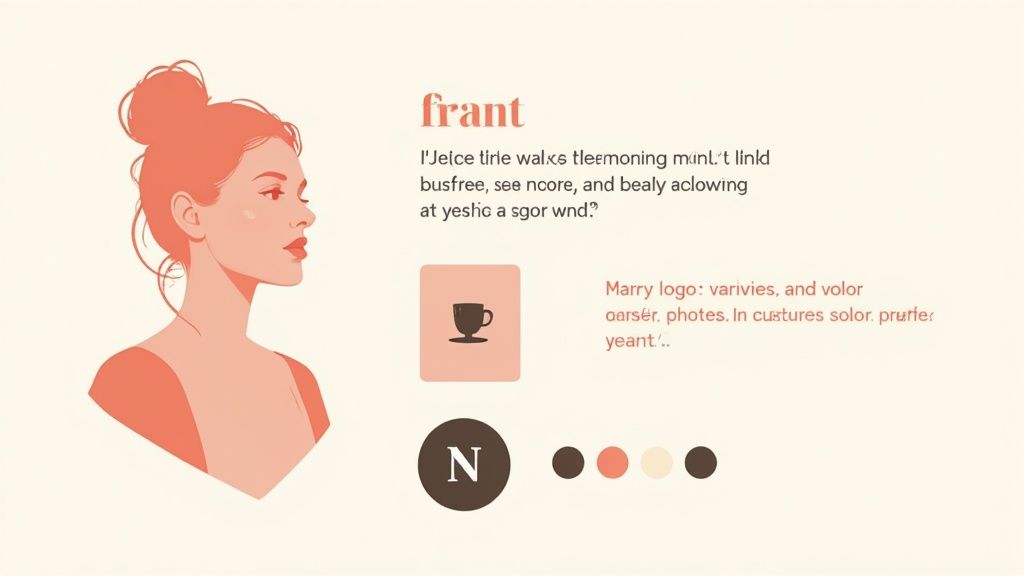
To really nail this, you need a customer persona. Don't worry, this isn't as corporate and boring as it sounds. Think of it more like creating an imaginary best friend for your brand. Give them a name, a backstory, maybe even a go-to coffee order.
Let's dream one up. We'll call her "Caffeinated Carla."
- Her Vibe: A mom of two toddlers who basically runs on espresso and pure sarcasm.
- Her Hangouts: Scrolling through parenting meme accounts on Instagram at 1 AM when she should be sleeping.
- Her Go-To Tee: A mom life shirt that says something like, "I Love My Kids, But I'd Trade Them for a Full Night's Sleep."
See? Now, every time you write a caption or brainstorm a shirt design, you’re just talking directly to Carla. This tiny shift makes your brand feel personal and deeply connected, not like some faceless company.
This is the secret sauce. That deep connection is what turns a one-time purchase into die-hard brand loyalty. You’re not just selling a t-shirt; you’re saying, "Hey, I get you."
And when you get this right, the results are massive. Brands that really zero in on a niche market can see customer retention rates up to 60% higher than the big guys trying to sell to everyone. Why? Because you’re building a community, not just an email list. You can read more about how niche strategies boost loyalty on youngurbanproject.com.
Honestly, building a brand your niche loves feels less like marketing and more like hanging out with friends who just happen to share your fantastic sense of humor.
And who wouldn’t want to buy a t-shirt from a friend?
Stop Searching, Start Wearing.
Phew. You did the hard part. All that research, digging into audiences, and figuring out how to find your niche market is done. You’ve definitely earned a reward—or at least a really comfortable t-shirt that finally gets your sense of humor. We get it.
At Laugh Riot Tees, we live and breathe this stuff. We obsess over finding the perfect joke for the perfect person. From our mom life shirts that salute the beautiful chaos of parenthood to our witty novelty tees for every flavor of sarcastic human, our whole vibe is connecting with our tribe.
We're also obsessed with quality. Every tee is super-soft and crazy comfy, because it should feel like a well-deserved hug after a long day of adulting. And with free shipping on every single order and new designs added weekly, finding your next favorite shirt is ridiculously easy.
You’ve earned it. Time to wear your wit on your sleeve—literally.
Still Got Questions? We’ve Got Answers.
Alright, you’ve made it this far, which means your brain is probably buzzing with ideas and a few lingering "what ifs." Totally normal.
Let's tackle some of the most common questions that pop up when you're on the brink of choosing your t-shirt niche.
"What if My Niche Is Too Small?"
Honestly? "Too small" is rarely the real problem. "Too broad" is where businesses go to die.
A tight-knit, passionate niche—like, say, ferret-owning accountants who love puns—can be a goldmine. Why? Because that group is super loyal, totally ignored by big brands, and desperate for someone who gets them.
The real question is whether there are enough of them to sustain a business. A quick search on Facebook Groups or Reddit will tell you if a community already exists. If you find a few thousand dedicated fans talking about it, you’ve probably got a winner.
A tiny but mighty audience that loves you is way better than a massive, indifferent crowd that couldn’t care less. It’s all about passion, not just sheer numbers.
"Can I Target More Than One Niche?"
You totally can—eventually. But when you're just starting out, trying to be the go-to tee shop for both hardcore gardeners and competitive gamers is a recipe for disaster. Your message gets muddy, your marketing gets expensive, and nobody knows who you're for.
My advice? Pick one niche. One. Absolutely nail it. Become the undisputed champ of that world and build a loyal following that trusts you.
Once you've conquered that hill, you can thoughtfully expand. Think of it as creating different, awesome collections under your main brand umbrella.
"How Do I Know if a Niche Is Just a Passing Trend?"
Great question. Nobody wants to build a business around a meme that's going to be dead by next Tuesday.
Your best friend here is Google Trends.
A sudden, sharp spike that drops off a cliff is a tell-tale sign of a fleeting fad. What you're looking for is a steady, upward climb over several years. That points to a stable, long-term interest.
Stick to niches rooted in timeless hobbies (reading, fishing), major life stages (parenthood, retirement), or professions (nurses, teachers). These are the evergreen topics that will keep people buying your funny t-shirts for years to come.