

Social Media Marketing for Small Business: A Guide for People Who'd Rather Be Napping
Let's be real. Tackling social media marketing for a small business feels like being told to assemble IKEA furniture in the dark, with no instructions, while your toddler "helps." You're already the CEO, the janitor, and the head of emotional support. Now you have to be a meme lord, too? It’s enough to make you want to fake your own death and move to a cabin with no Wi-Fi.
But what if I told you it doesn't have to suck?
Your Guide to Social Media Without the Meltdown
Okay, deep breath. We get it. Shoving "social media guru" onto your to-do list, somewhere between "invent more hours in the day" and "finally wash that pile of laundry," feels like a sick joke. But I promise, it's not as scary as it sounds. Let’s ditch the corporate jargon and the insane pressure to go viral by lunchtime.
Think of social media as the front porch of your online store. It's where you hang out, tell bad jokes, and find your people—the ones who get your sarcastic sense of humor and actually buy your stuff. This isn't about posting impossibly perfect photos. It's about being the awesome, slightly chaotic human behind the brand. Nobody falls in love with a logo, but they'll absolutely connect with the person who also believes Mondays should be optional.
This isn’t just some "nice-to-have" thing; it's one of the best (and cheapest) ways to grow. We're talking about building a real crew of fans who do more than just buy your funny t-shirts—they become your personal hype team. And honestly, there's no better feeling than seeing a stranger rocking one of your tees in the wild.
What We Are Covering
This guide is your straight-up, no-fluff roadmap to get you from "What fresh hell is this?" to "Okay, I got this." We're breaking it all down, minus the headache. Here's what we're getting into:
- Setting Goals That Don't Suck: We'll help you figure out what "winning" actually looks like for you—whether that's more sales, a bigger following, or just not crying at your desk.
- Finding Your People: Let's figure out who your customers really are. (Spoiler: they probably love wine, relatable memes, and ridiculously comfy novelty tees as much as you do).
- Choosing Your Playground: You don’t need to be everywhere at once. We’ll help you pick the one or two platforms where your future besties are already doom-scrolling.
- Creating Killer Content: From hilarious Reels to memes that make people spit out their coffee, we'll dive into how to make stuff that people actually want to share.
Building a brand is a marathon, not a sprint, and your social media is a massive part of that story. For a deeper look at the other pieces of the puzzle, check out our guide on how to build a clothing brand. We’re in this to build something that lasts, one laugh at a time.
Choosing Your Social Media Playground
Let's be real. Trying to be everywhere on social media is a one-way ticket to Burnout City. Population: you. Not every platform is created equal, and your small business doesn’t need to be on all of them. Think of it this way: you wouldn't set up a pop-up shop in a random alley, right? You'd go where the people are.
Wasting your time posting hilarious novelty tees on LinkedIn is like trying to sell ice to a penguin—pointless and a little weird. The whole game is picking the right sandbox to play in, where your ideal customers are already hanging out, just waiting to find their new favorite shirt.
Finding Your Tribe's Home Turf
Before you post a single thing, you need to figure out where your people live online. It’s a big deal. More than 55% of consumers discover new brands on social media, so picking the right spot is everything.
Let’s break down the big players and their distinct “vibes” so you can find your brand’s new best friend.
- Instagram (The Visual Wonderland): If your products are eye candy, this is your home. We're talking high-quality photos of your awesome tees, behind-the-scenes Reels of your chaotic packing process (toddler "help" and all), and interactive Stories. It’s perfect for brands that can show, not just tell.
- Facebook (The Community Hub): With over 3 billion monthly users, Facebook is the giant neighborhood block party of the internet. It's fantastic for building a real community, sharing updates, and running super-targeted ads to people who actually have "mom life shirts" listed as an interest.
- TikTok (The Trendsetter's Paradise): This is where raw, unfiltered fun goes to thrive. If your brand is built on witty one-liners and relatable humor, TikTok's short, snappy videos are your secret weapon. It’s less about polished perfection and all about personality.
- Pinterest (The Digital Vision Board): People go to Pinterest to plan, dream, and buy. If your funny t-shirts fit into niches like "bachelorette party ideas," "gifts for coffee lovers," or "sarcastic mom style," creating beautiful Pins can drive serious traffic to your website for months, even years, to come.
To make this even easier, here’s a quick-glance comparison to help you decide where to focus your energy based on who you're trying to reach and what you're trying to say.
Which Social Media Platform Fits Your Small Business
| Platform | Best For... | Audience Vibe | Content Style |
|---|---|---|---|
| Lifestyle brands, e-commerce, visual products | Trendy, creative, and engaged (Millennials & Gen Z) | Polished photos, Reels, Stories, influencer collabs | |
| Building communities, local businesses, reaching a broad age range | Diverse, community-focused (Gen X & Millennials) | Updates, articles, videos, user-generated content, ads | |
| TikTok | Brands with personality, trend-focused products | Young, fun-loving, entertainment-seekers (Gen Z) | Short-form video, humor, challenges, raw & authentic |
| Home goods, fashion, food, DIY, anything with a visual "how-to" or inspirational angle | Planners, dreamers, and shoppers (female-dominated) | High-quality vertical images (Pins), infographics, tutorials |
Ultimately, the best platform is the one that feels like a natural fit for your brand and connects you with your people.
Still on the fence about whether it's worth the effort? This little decision tree should clear things up.
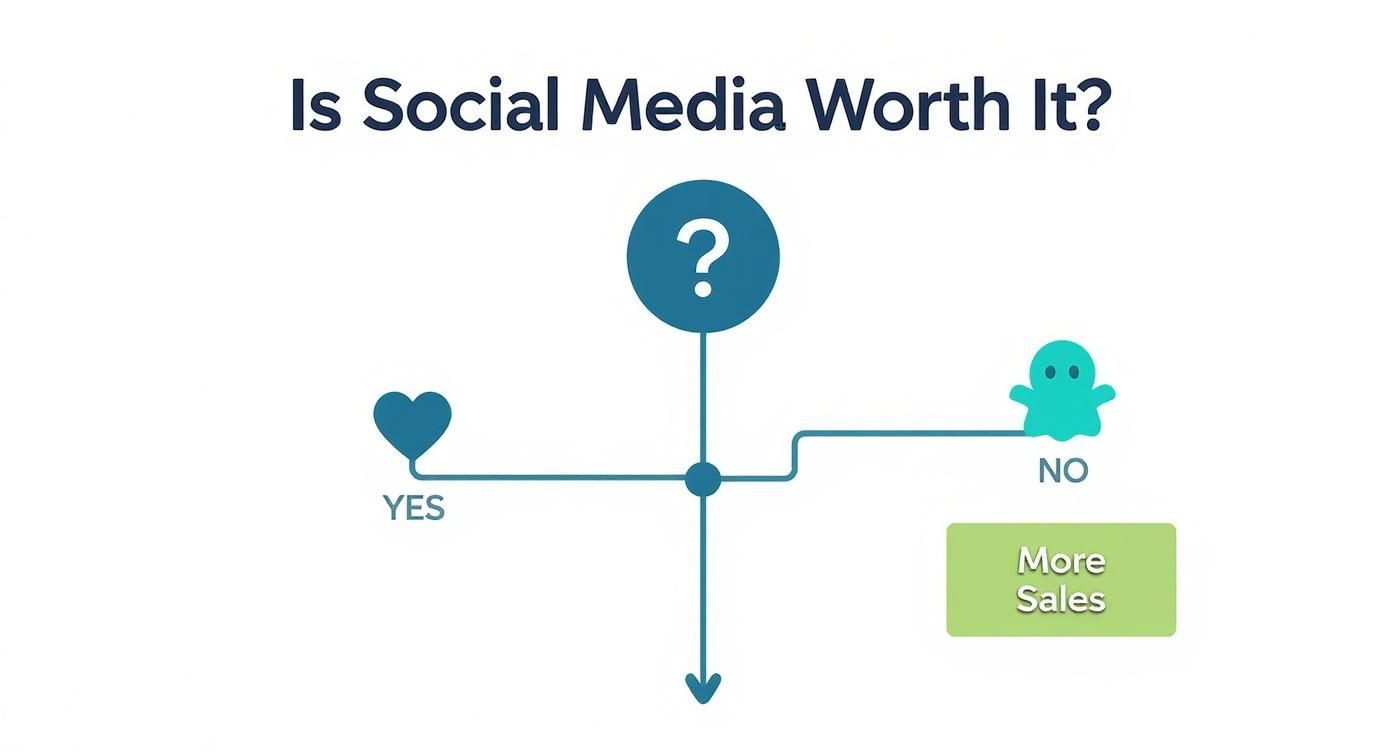
The takeaway here is simple: if you want to grow and connect with customers, social media isn't just an option anymore. It's the main event.
Match Your Vibe to the Platform
So, how do you officially choose? Don't overthink it. Just ask yourself two simple questions.
First, where does your content naturally shine? If you’re a natural comedian on camera, TikTok and Instagram Reels are calling your name. If you excel at styling your tees and taking gorgeous photos, Instagram and Pinterest are your jam.
The goal is to play to your strengths. You don't need to become a professional videographer overnight. Start with what feels easy and fun—your audience will feel that authenticity.
Second, where is your target audience already hanging out? If you sell relatable shirts about surviving parenthood, you’ll find your people in Facebook groups for moms and scrolling through #momlife on Instagram. Go where the conversation is already happening.
Start with one or two platforms, get really good at them, and then you can think about expanding your empire. No need to conquer the world on day one.
Creating Content People Actually Want to See
Let me let you in on a little secret: your content doesn’t need to be perfect. Read that again. It doesn’t need to be polished, professionally shot, or blessed by a Hollywood director. It just needs to feel like you.
The real goal of social media marketing for a small business isn’t to scream “BUY MY STUFF!” into the void. It’s to make someone stop scrolling, laugh out loud, and think, "Oh my god, I need that shirt in my life right now."
You’re not just selling funny t-shirts; you’re selling a feeling. You’re selling that aha! moment when a customer sees a design that perfectly captures their internal monologue. That's the magic we need to bottle up and pour into every single post.
The Holy Trinity of Content
For a brand like ours, every single post should nail at least one of these three things. The real home run is when you hit all three at once.
- Humor: This is our bread and butter. It's the entire vibe of Laugh Riot Tee’s. Every piece of content should be witty, a little cheeky, and genuinely funny. Think memes, relatable skits, or just a perfectly sarcastic caption.
- Relatability: This is what makes people feel seen. It’s the "mom life" chaos, the desperate need for more coffee, the universal eye-roll at another meeting that could have been an email. When people see themselves in your content, they form an instant bond.
- Value: This one can feel tricky. For us, "value" isn't a 10-step guide to financial freedom. It’s a laugh on a tough day, a behind-the-scenes peek at how their favorite novelty tee is made, or a fun poll that lets them help name a new design. It's about giving them something more than just a product photo.
When you mix these three, you create content that doesn’t feel like an ad. It feels like a post from a friend. And that, my friend, is how you turn a casual scroller into a loyal fan who actually looks forward to what you post next.
Brainstorming Content That Connects
Staring at a blank content calendar is the worst. So let’s fill it up with ideas that actually work for a brand that sells humor. Ditch the boring product shots on a plain white background—it’s time to get creative.
Here are a few ideas to get the gears turning:
- Turn Reviews into Memes: Got a hilarious customer review? Slap that text onto a popular meme format. It’s authentic social proof, and it’s way more entertaining than a generic testimonial.
- Behind-the-Scenes Chaos: Film a Reel of you trying to pack an order while your toddler "helps" by decorating the shipping boxes with crayons. It's real, it's funny, and it perfectly captures the vibe of your mom life shirts.
- "Name Our Next Tee" Polls: Let your audience in on the fun. Post a new design in your Instagram Stories and run a poll to let them vote on the perfect witty name for it. People love having a say, and it makes them feel invested.
- Style It Up: Don’t just show the shirt; show the outfit. Create a simple carousel post showing how to style one of your tees for a casual weekend, a coffee run, or a night in with a bottle of wine.
The key is to think like a content creator, not just a business owner. Ask yourself, "Would I stop scrolling for this?" or "Would I share this with a friend?" If the answer is no, head back to the drawing board.
Choosing the Right Format for Your Message
Not all content formats are created equal. The trick is matching your idea with the best way to serve it up. Let's break down the main players and when to use them.
1. Static Images and Carousels
- What they are: High-quality photos, graphics, memes, or a series of images someone can swipe through.
- When to use them: Perfect for showing off new designs, sharing those hilarious customer-review memes, or creating mini-guides (like our styling example). Carousels are gold because they keep people on your post longer, which the algorithm absolutely loves.
2. Short-Form Video (Reels & TikToks)
- What they are: Quick, punchy videos, usually under 60 seconds, often set to trending audio.
- When to use them: This is your personality playground. Use them for behind-the-scenes glimpses, packing orders, day-in-the-life vlogs, or acting out a funny skit that relates to one of your shirt designs. Video is king for reach right now, so don't be shy.
3. Stories
- What they are: Temporary, 24-hour content that feels way more informal and in-the-moment.
- When to use them: Stories are for conversation. Use them for daily check-ins, polls, Q&As, sharing user-generated content, and linking directly to products. They’re less about perfection and more about building that day-to-day connection with your followers.
Growing Your Audience Without Spending a Dime
Alright, you’re creating killer content that’s funnier than your dad’s favorite joke. Now for the million-dollar question: how do you get people to actually see it without emptying your bank account?
Welcome to the world of organic growth. This is all the stuff you can do for free to build a real, ride-or-die community. It's less about chasing one viral moment and more about playing the long game—one clever hashtag and genuine comment at a time.
This approach is the backbone of social media marketing for small business, and it's how you turn casual scrollers into loyal fans who can’t wait to buy your latest novelty tees.
The Art of the Hashtag
Let's get one thing straight: throwing #funny or #tshirt on your post and calling it a day is like whispering a secret in a hurricane. It’s just not going to work.
The real magic is in the mix—using a cocktail of hashtags that speak to different groups of people.
Think of it like this:
-
Broad Hashtags (The Megaphone): These are the big ones like
#graphicteesor#smallbusiness. They get your post out there, but the competition is fierce. Stick to just one or two. -
Niche Hashtags (The Inside Joke): This is where you find your people. Think
#momlifebelike,#sarcasticshirts, or#coffeeloversunite. These are specific, targeted, and attract an audience that already gets your vibe. Use three to five of these. -
Branded Hashtags (Your Secret Handshake): Create one just for your brand, like
#LaughRiotTees. Encourage customers to use it when they post photos in your gear!
Using the right combo is like giving the algorithm a perfectly drawn map that leads directly to your ideal customer. It’s a small effort with a massive payoff.
Community Is Your Superpower
Social media isn't a billboard; it's a block party. You can't just show up, shout about your awesome shirts, and leave. You have to mingle, chat, and actually be… well, social. This is where so many small businesses drop the ball, but it's your chance to shine.
This isn’t just a nice idea—it’s a proven strategy. Small businesses get it, with 96% now using social media in their marketing. A huge chunk of them, 71%, use it specifically for marketing, while 44% focus on building brand awareness. This shows that connecting directly with people is the new normal. You can check out more about how businesses are using these platforms with these insightful social media marketing statistics from Landingi.com.
Your comment section is a goldmine. Every question, compliment, or tagged friend is an opportunity to build a relationship. Reply to as many as you can—with personality, not a generic "Thanks!"
Engaging with your audience turns followers into a community. When people feel heard, they stick around. They buy more. And they tell their friends about the awesome brand that actually talked back to them.
Let Your Customers Do the Talking
User-Generated Content (UGC) is the holy grail of organic marketing. It’s when a customer loves their new relatable shirt so much that they post a picture of themselves wearing it and tag you.
It's authentic, it's powerful, and it's free advertising.
So, how do you get more of it? Just ask!
- Run a simple contest: "Share a photo in your favorite Laugh Riot Tee for a chance to win a gift card!"
- Add a small note to your packaging encouraging people to share their photos and tag you.
- Regularly feature customer photos on your feed and in your Stories (always with their permission, of course).
When potential buyers see real people rocking and loving your products, it builds instant trust and makes them want to join the fun. If you're selling on other platforms, this kind of social proof is invaluable. For more on that, you might be interested in our guide on how to sell on Etsy successfully. It dives deep into building trust with customers, no matter where you sell.
Using Paid Ads Without Crying About Your Budget
Let's be real: the phrase "paid ads" makes most small business owners clutch their wallets. It sounds expensive, complicated, and like something reserved for giant corporations with marketing departments bigger than your entire house.
Relax. Take a deep breath. We're not talking about Super Bowl commercials here.
Think of paid ads less as a terrifying expense and more like giving your funniest, most-loved posts a shot of espresso. It’s about getting your best stuff in front of the exact right people, without needing to sell a kidney to do it.
Start Small, Boost Your Winners
The absolute easiest way to dip your toes in is by "boosting" a post on platforms like Instagram or Facebook. This just means paying a few bucks to show a post that’s already a hit with your followers to a much wider, targeted audience.
So, let's say you posted a meme about surviving the holidays that got a ton of likes and "omg, so true" comments. That's your golden ticket. You can boost that post for as little as $5 a day and show it to thousands of other people who will see it, laugh, and think, "Finally, someone gets me... and I need that funny t-shirt."
This isn't about throwing money at every single thing you post. It's about spotting your superstars—the content that already makes people smash the 'like' button—and putting a little rocket fuel behind them.
Boosting is your training wheels for paid social media. It’s low-risk, easy to understand, and you’ll see the impact almost immediately.
Find Your People with Targeting
Okay, here’s where the real magic happens. Paid ads let you get ridiculously specific about who sees your content. This is called targeting, and it’s how you make sure every dollar you spend is pulling its weight.
You can show your ads to people based on:
- Interests: Target people who have liked pages about "sarcastic humor," "wine memes," or even your competitors.
- Demographics: Selling a bunch of mom life shirts? You can aim your ads directly at moms in their 30s living in suburban Ohio. It’s that precise.
- Lookalike Audiences: This is a total game-changer. You can give Facebook a list of your best customers, and its algorithm will go out and find a brand-new audience of people who look and act just like them online. It's basically cloning your biggest fans.
This laser-focus means you stop wasting money showing your ads to people who would never buy from you. Instead, you're placing your best relatable shirts right in the feeds of people who are practically guaranteed to love them. When you’re only reaching the most relevant shoppers, you’re taking a massive step toward improving your ecommerce conversion rates.
And the best part? This doesn't require a monster budget. The cost for an ad on Meta (Facebook & Instagram) can often be less than $1 per click. This means small businesses can see real results by spending just a few hundred dollars a month. In fact, many experts recommend dedicating 30-50% of a marketing budget to social media for this very reason.
When you get your targeting right, your ad doesn't feel like an annoying interruption. It feels like a discovery. And that's how you turn a small ad spend into a big-time win.
Partnering With Creators Who Get Your Brand
Forget trying to get The Rock to wear one of your funny t-shirts. Unless you’ve got a Hollywood-sized budget, that’s just not happening. The real magic in social media marketing for small business today comes from a different kind of celebrity: the micro-influencer.
These are creators with smaller, but incredibly dedicated, audiences. Think of them as the coolest kid in a super-specific friend group. When they suggest something, their friends actually pay attention. A mega-star with millions of disconnected fans might get you a bunch of likes, but a creator with 10,000 followers who genuinely loves witty apparel will get you sales.
Their recommendation feels like a tip from a friend, not some stiff, corporate sales pitch. It’s authentic, believable, and way, way more effective.
Why Micro-Influencers Are a Small Business’s Secret Weapon
Let’s talk numbers for a second. Influencer marketing is a beast, but the sweet spot is with the smaller creators. On Instagram, micro-influencers (those with 10,000 to 100,000 followers) pull in an average engagement rate of 3.86%. Compare that to just 1.21% for the big-shot macro-influencers. It all comes down to trust; a whopping 61% of consumers trust what influencers recommend more than what brands say in traditional ads. You can dig into more of these eye-opening numbers in these social media marketing statistics on Sprinklr.com.
For a small business, this is pure gold. It means you don't need a massive budget to make a real impact. You just need to find the right people who actually get your brand’s sense of humor.
How to Find Your Perfect Partners Without Going Broke
Finding the right creators isn’t about endlessly scrolling—it’s about smart searching. You're on the hunt for someone whose vibe just clicks with your brand. Someone who would genuinely wear your relatable shirts even if they weren't getting paid.
Here are a few ways to track them down:
-
Dig Into Your Hashtags: Search for niche hashtags that fit your brand’s humor, like
#sarcasticmomlifeor#bookwormhumor. See who’s posting great content and getting tons of real comments (not just bot spam). - Look at Your Own Followers: Who are your current superfans? Sometimes your best brand advocate is already following you and loving everything you post. A quick peek at your most engaged followers can uncover some hidden gems.
- Go Down the Rabbit Hole: Find a creator you like, head to their profile, and check out who Instagram suggests you also follow. This is a great way to discover a whole network of perfectly aligned potential partners.
Once you find someone who seems like a great fit, slide into their DMs or shoot them an email. Start with a real compliment about their content. Then, offer them a free novelty tee of their choice in exchange for a post or a Story mention. It’s a low-cost, low-risk way to start building relationships and get your products in front of a brand new, perfectly targeted audience.
Quick Answers to Your Toughest Social Media Questions
Alright, let's get into the stuff that keeps you up at 3 AM, scrolling through your feed with one eye open. You've got the basics down, but social media comes with some seriously tricky questions that feel impossible to answer.
This is your no-nonsense, straight-to-the-point guide for when you feel totally stuck.
How Do I Handle Negative Comments Without Having a Meltdown?
First, take a deep breath. Step away from the keyboard. I know it feels personal—it’s your brand!—but it’s usually not.
The golden rule is this: respond publicly, but solve privately. A simple, professional reply shows everyone you’re on top of it without starting a public argument. Something like, "We're so sorry to hear you had this experience. I'm sending you a DM right now to make this right," is perfect.
And for the trolls? Don’t feed them. A swift block and delete is your best friend here. It's your page, your rules.
How Do I Know If Any of This Is Actually Working?
Likes are nice, but they don't pay the bills. To see if your strategy is really paying off, you need to look beyond those vanity metrics.
The real signs of success are the things you can actually count—the actions people take.
- Website Clicks: Are people leaving your social page and actually heading to your shop? Your analytics will tell you the real story.
- Engagement Rate: This isn’t just about likes. It’s the percentage of your followers who are actively commenting, sharing, and saving your posts. This shows you’ve built a real community, not just a passive audience.
- Direct Messages: Are people sliding into your DMs to ask about sizing for a funny t-shirt or when a sold-out design will be back in stock? That’s a massive buying signal.
If your followers are taking action—clicking to your site, asking questions, and sharing your content with friends—you're on the right track. That’s how you know your social media efforts are turning into real business results.
Seriously, How Much Time Should This Take Every Week?
Let's be real, you don't have 40 hours a week to dedicate to this. You're running a business!
Aim for 3 to 5 hours a week of focused effort. This isn't about being online 24/7; it's about being smart with the time you have. Batch-create your content one afternoon, schedule it all out, and then just pop in for 15-20 minutes a day to engage with comments and messages.
Consistency beats intensity every single time.
At Laugh Riot Tee’s, we get that life's too short for boring clothes. That’s why our shirts are made from ridiculously soft, high-quality fabric that feels like a weekend hug. We drop hilarious new designs every week because your wit deserves a wardrobe to match. Plus, you’ve earned it—so shipping’s always on us.