

What Is a Print on Demand Business? And How Can I Start One Yesterday?
Picture this: You dream up the world's most brilliant t-shirt idea (probably in the shower). You upload the design. Someone buys it. You get paid. All while you’re still in your pajamas, never once having to sniff a roll of packing tape.
That, my friend, is the ridiculously awesome magic of a print-on-demand business. It’s the perfect, low-risk way for creative geniuses like you to sell custom gear online without turning your garage into a sad, cramped warehouse of unsold dreams.
So, What Is a Print-on-Demand Business, Really?
Let’s be real. The fantasy of starting your own t-shirt brand sounds amazing until you picture stacks of boxes filled with unsold inventory, silently judging you from the corner of your basement.
Print on demand (POD) lets you skip that entire nightmare. It’s a business model where you, the creative powerhouse, partner up with a third-party supplier to sell products plastered with your awesome designs.
Think of it like having a personal chef for your t-shirt ideas. You create the recipe (your hilarious design for a mom life shirt), and when a customer orders it, the chef (your POD partner) cooks it up, packages it beautifully, and ships it right to their door. You never have to buy the ingredients or wash a single dish. Pretty sweet deal, right?
This hands-off approach to fulfillment is exactly why the POD model is exploding. The global print-on-demand market was valued at a whopping $8.16 billion in 2025 and is on track to nearly triple to $19.8 billion by 2029. It seems a lot of people are catching on to this "work smarter, not harder" vibe. You can read more about these print-on-demand trends to see just how fast this thing is growing.
Who Does What in This Magical Partnership?
This whole setup frees you up to focus on the fun stuff—dreaming up relatable shirt ideas and building a community around your brand—while someone else handles the boring logistics.
You’re not just an artist; you're the brand owner, the creative director, and the marketing guru. Your partner is the silent, efficient muscle working behind the scenes to make it all happen.
To break it down even further, here’s a quick look at who handles what.
Print on Demand at a Glance
This little table sums up how you and your partner split the work. You get the glory; they get the grunt work.
| What You Do (The Fun Part) | What Your POD Partner Does (The Boring Part) |
|---|---|
| Create awesome, funny designs for novelty tees. | Prints your design on a blank product when an order comes in. |
| Build your online store and market your products. | Handles all the inventory, from storage to management. |
| Engage with your customers and build a loyal brand. | Packages the final product securely for shipping. |
| Set your own prices and collect the profits. | Ships the order directly to your happy customer. |
See? You get to be the rockstar, and your POD partner is your roadie, making sure the show goes on without a hitch. It’s the simplest way to get your creative ideas out into the world and into the hands of people who will love them.
How the Print on Demand Process Actually Works
So, you’ve got a killer idea for a funny t-shirt. Awesome. But how does that stroke of genius actually become a real-life, super-soft tee on someone’s doorstep? It sounds complicated, but trust me, it’s easier than successfully sneaking snacks into a movie theater.
The whole thing is a beautifully simple, hands-off dance. You handle the creative part, your partner handles the production part, and you both get paid. It’s like having a team of highly efficient elves who live to print, pack, and ship your hilarious designs. All while you’re busy coming up with more comedy gold… or, you know, re-watching your favorite show for the fifth time. We get it.
This quick visual breaks down the simple three-step flow from your brain to your customer's mailbox.
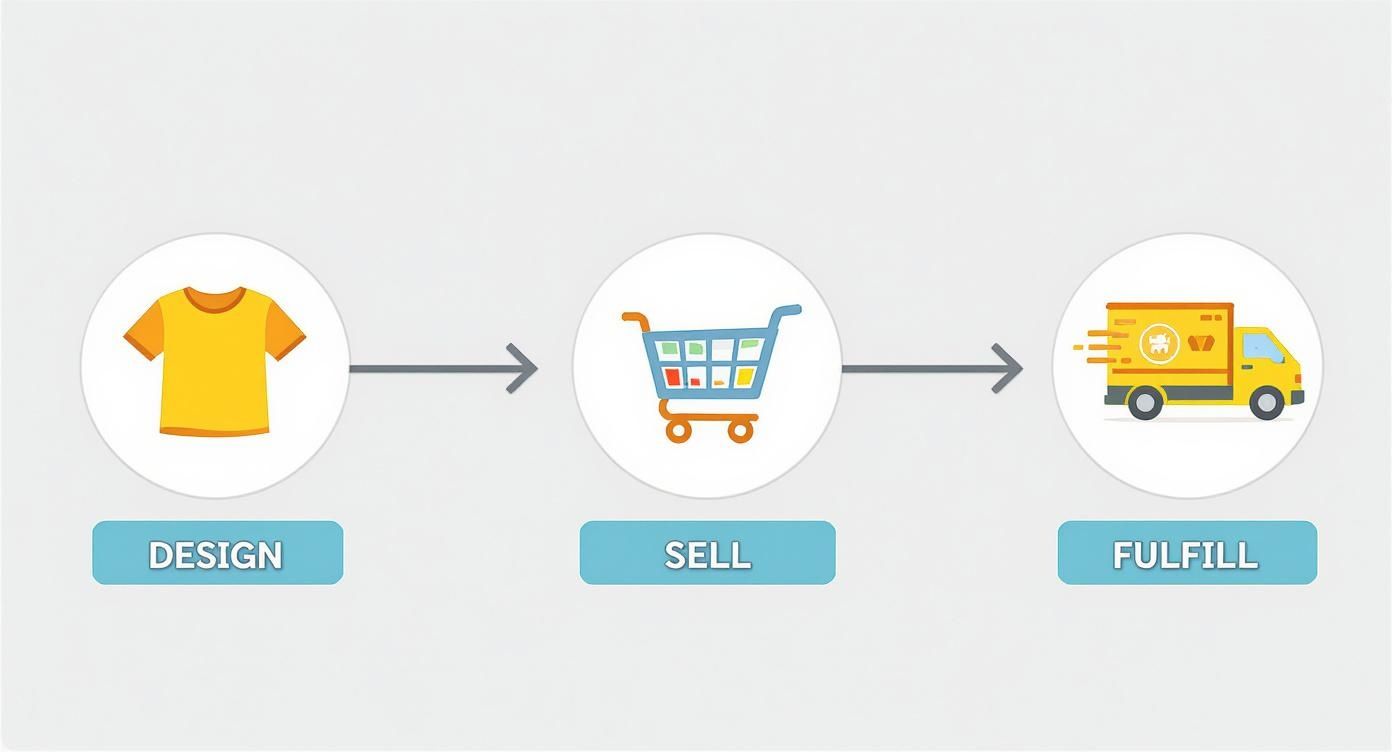
As you can see, your job is all about the fun stuff—design and sales—while your partner takes care of all the physical grunt work. Let's break down each step of that journey.
Step 1: You Create the Design and Set Up Shop
This is where the magic begins. You come up with a design that’s just too good not to share—maybe it’s a relatable shirt for exhausted parents or a novelty tee that only fellow cat lovers will appreciate. You finalize your design file, making sure it’s high-resolution and ready to print.
Next, you set up your online storefront. This is your digital stage, the place where you’ll show off your masterpieces. You upload your design to a product in your chosen print-on-demand partner’s catalog, creating what’s called a "virtual product" or a mockup. It looks totally real to the customer, but there’s no physical shirt… yet.
Step 2: A Customer Falls in Love and Places an Order
Someone stumbles upon your store, sees your brilliant design, and thinks, “I need that in my life.” They add it to their cart and hit that glorious ‘buy’ button. Cha-ching! The order is officially placed on your website.
This is the pivotal moment. Instead of you getting an alert to go dig through boxes in your garage, the order is automatically and instantly sent to your print-on-demand partner. You don’t have to do a single thing. It all happens in the background.
Step 3: Your Partner Prints, Packs, and Ships
Once your POD partner gets the order, their team springs into action. They grab a blank t-shirt from their warehouse, fire up their high-tech printing machines, and bring your design to life. Most partners use a method called Direct-to-Garment (DTG) printing, which is basically a super-sophisticated inkjet printer for fabric. If you want to dive deeper into the tech, you can learn more about what Direct-to-Garment printing is in our detailed guide.
After the design is printed and quality-checked, they package it up and ship it directly to your very happy customer. They handle the shipping labels, the postage, and all the tracking info. You just get a notification that the order has shipped, and more importantly, you get paid your profit.
You've just sold a product you never had to physically touch. Welcome to the future.
The Pros and Cons of a Print on Demand Business
Alright, let’s get real. The idea of a print-on-demand business can sound like a dream—you upload a funny design, people buy it, and money magically appears in your bank account.
But it’s not all witty one-liners and easy profits. Like any business model, POD has some incredible perks and some… let’s just call them “character-building” realities. Before you dive headfirst into designing the world’s next viral novelty tee, it’s smart to know exactly what you’re signing up for.
The Amazing Benefits (Pros)
First up, the stuff that makes print on demand so ridiculously appealing. This is the part that lets you sleep at night instead of having nightmares about a garage full of unsold t-shirts.
-
Practically Zero Startup Costs: This is the big one. You don't need to take out a small loan to buy 500 t-shirts in six different sizes. You can literally start this business with nothing more than a good idea. No inventory means absolutely no financial risk if a design doesn't sell.
-
Endless Creative Freedom: Got a super niche idea for a shirt about the existential dread of folding laundry? Go for it. Since you’re not pre-buying stock, you can launch a dozen, or even a hundred, different designs to see what sticks. It’s the ultimate creative playground.
-
No Logistical Headaches: Forget about packing tape, shipping labels, and trips to the post office. Your POD partner handles all the printing, packing, and shipping. This frees you up to focus on the fun stuff: creating hilarious designs and marketing them.
-
Work from Anywhere: As long as you have a laptop and an internet connection, you can run your empire. From your couch, a coffee shop, or a beach somewhere—your business is as portable as your sense of humor.
The Not-So-Great Realities (Cons)
Now for the other side of the coin. It’s not all sunshine and profit margins. Understanding these downsides is key to building a smart strategy and keeping your expectations in check.
The honest truth is that convenience comes at a price. While you skip the upfront costs and physical labor, you trade that for lower profits and less control over the final product. It’s a classic business trade-off.
-
Lower Profit Margins: This is probably the biggest drawback. Because you’re paying for a one-off printing and fulfillment service for each order, the cost per item is way higher than buying in bulk. Your profit on a single t-shirt will be smaller, which means you need to sell a lot more to make significant income.
-
Less Control Over Quality and Shipping: You are completely at the mercy of your POD partner. If they have a bad print day or their shipping times suddenly get slow, it's your brand that takes the hit. This makes choosing a reliable partner absolutely critical.
-
Limited Customization: While you control the design on the shirt, you don't have much say over anything else. You can’t add a custom thank-you note or use fancy branded packaging unless your POD partner offers it (and they usually charge extra for it).
-
You Handle the Customer Service: When an order is late or a print looks wonky, the angry customer comes to you, not your supplier. You’ll be the one managing communications and finding a solution, playing middleman between your customer and the printing company.
Is Print on Demand the Right Fit for You?
So, is this model the golden ticket for your t-shirt empire? It all comes down to what you value most. Do you crave creative freedom and low risk, or are you aiming for maximum profit and total control?
This table breaks it down, no fluff.
| The Amazing Benefits (Pros) | The Not-So-Great Realities (Cons) |
|---|---|
| No Upfront Investment: Start with basically zero money down. | Slimmer Profit Margins: You make less per shirt than with bulk inventory. |
| Total Creative Freedom: Test unlimited designs without financial risk. | No Quality Control: You rely entirely on your partner for quality and shipping. |
| No Inventory or Shipping: Your partner handles all the logistics. | Limited Branding: Your packaging and unboxing experience are generic. |
| Work From Anywhere: Run your business from a laptop. | You're the Middleman: All customer service issues fall on you. |
Ultimately, weighing these points will help you decide if this hands-off approach is the perfect fit for your funny t-shirt dreams. For many, the ability to get started with zero risk is more than worth the trade-offs.
How to Choose a Print on Demand Partner (Without Losing Your Mind)
Alright, let's talk about the single most important decision you'll make in your print-on-demand journey (other than deciding if a t-shirt about tacos is too niche—it’s not). Picking your POD partner is like choosing a lead guitarist for your one-person rock-and-roll t-shirt operation. If they suck, your masterpiece will sound like a mess, and it’s your name on the ticket.
Your partner is the silent force that turns your brilliant designs into real, huggable apparel. They handle the printing, the packing, and the shipping. A great one makes you look like a pro. A bad one… well, a bad one will send your customers shirts that fade faster than your New Year's resolutions. No pressure.
This decision is critical because it directly impacts your brand's reputation. And with the U.S. POD market projected to surge from $2.53 billion in 2024 to an insane $26.95 billion by 2034, you want a partner who can keep up. If you want to see just how explosive this market is, you can dig into the numbers on Podbase.com—it’ll show you why picking a solid partner is so crucial for the long haul.
Key Things to Look For in a POD Provider
So, how do you vet these potential business partners without awkward speed-dating? You need a checklist. Here’s what truly matters when you're swiping right on a fulfillment company.
-
Product Catalog Quality: Let's be real, nobody wants a funny t-shirt that feels like sandpaper. Does the provider offer the kind of ridiculously soft, high-quality shirts you’d actually wear yourself? Look for brands you know and love, and make sure they have a good mix of colors and sizes.
-
Print Quality That Lasts: A killer design is useless if it cracks, peels, or fades after one wash. This is non-negotiable. Hunt for providers with consistently high reviews for their print work.
-
Reasonable Shipping Times and Costs: In a world of two-day shipping, your customers have zero patience. Check your provider’s average fulfillment and shipping times. Are they upfront about costs? Slow, expensive shipping is a guaranteed way to lose customers at checkout.
-
Seamless Platform Integration: Your POD partner needs to play nice with your online store, whether it’s on Shopify, Etsy, or somewhere else. A clunky integration means manual work for you, and nobody has time for that.
The Big Players: Printful vs Printify
You’ll hear two names thrown around constantly: Printful and Printify. Think of them as the Blur and Oasis of the POD world—both wildly popular, but with completely different vibes.
Printful operates its own production facilities. This generally means more consistent quality control and better branding options, but sometimes at a slightly higher price point. They’re the reliable, in-house specialist.
Printify is a network that connects you to dozens of different print providers all over the world. This gives you way more product variety and often lower prices, but quality can vary from one printer to another. It’s a marketplace, so you have to be a bit more hands-on with your vetting.
Neither is universally "better"—it's all about what fits your business. Do you want ultimate consistency (Printful) or more options and potentially lower costs (Printify)? For a deeper dive, check out our guide on how to build a clothing brand from scratch, which touches on the importance of your supply chain.
Ultimately, the best way to choose is to test them out. Order samples. Wear them, wash them, and abuse them a little. See whose quality holds up and whose process feels the smoothest. Your brand's reputation depends on it.
Tips for Creating Funny T-Shirts That Actually Sell
Alright, you get how the print-on-demand machine works. Now for the fun part: making stuff people actually want to buy. Let's be real, anyone can slap a lame joke on a t-shirt. But creating a truly funny tee that connects with an audience and flies off the virtual shelves? That takes a little bit of strategy and a whole lot of personality.
It’s about way more than just a punchline. It’s about creating something that makes someone stop scrolling and say, "That is SO me." That’s the secret sauce right there. And lucky for you, we’re about to spill it.
Find Your People and Your Niche
First things first: you can't sell to everyone. Trying to be funny to the entire world is a recipe for being funny to no one. The key is to find your niche—a specific group of people who share a common interest, inside joke, or daily struggle.
Think about it. A shirt that says "I Run on Caffeine and Chaos" is going to hit way different for a mom of three toddlers than it will for a retired accountant.
Pro Tip: Specificity sells. The more niche you get, the more your audience feels like you're speaking directly to them. That connection is what turns a casual browser into a loyal customer.
Here are a few goldmines for novelty tees:
- Hyper-Specific Hobbies: Think rock climbers, board game nerds, or people who are weirdly obsessed with their sourdough starters.
- Mom Life and Dad Jokes: This is an evergreen market. From relatable shirts about sleepless nights to eye-roll-worthy dad puns, this well never runs dry.
- Pet Ownership: Dog moms, cat dads, people who treat their reptile like a furry child—they all love to wear their pet-love on their sleeves (literally).
- Job-Specific Humor: Nurses, teachers, software developers… every profession has its own set of inside jokes just waiting to be put on a shirt.
Design for an Instant 'Get'
Once you know who you’re talking to, your designs need to be clean, simple, and instantly understandable. Someone scrolling through their phone should "get" the joke in under three seconds. If they have to squint, zoom in, or think too hard, you’ve already lost them.
Keep these design rules in mind:
- Legibility is King: Use bold, easy-to-read fonts. A super-fancy cursive script might look cool, but if no one can read it, it's just a scribble.
- Less is More: Don't clutter the design. A simple, punchy line of text often works way better than a complicated graphic with ten different elements.
- Contrast is Your Friend: Make sure your text and graphic colors pop against the shirt color. Black text on a white tee is a classic for a reason.
If you’re looking for more tips on the creative side of things, we've got a whole guide on making your own graphic tees that dives deeper into the art of design.
Always Order Samples. Seriously.
This is the most important tip on this entire list. I'm going to say it again for the people in the back: ALWAYS. ORDER. SAMPLES.
A design that looks brilliant on your screen can show up looking like a blurry, off-center disaster in real life. Colors can be totally off, the print quality might be garbage, and the shirt itself might feel like a burlap sack. You will never know until you hold it in your hands.
Trust me, there's nothing worse than getting an angry email from a customer because the "genius" design you sold them looks like it was printed with a potato. Ordering a sample is your one and only chance to do quality control. It's the difference between building a reputable brand that people trust and running a shop that gets shut down by bad reviews.
It’s what ensures your products meet the high standards you set—like the ridiculously soft, hilarious tees we stake our reputation on. This one step is non-negotiable for building a successful print-on-demand business, especially in a market that's blowing up. The POD market hit $6.25 billion in 2024 and is projected to keep climbing fast. You can get more insights into the impressive growth of print on demand on scoop.market.us.
Ready to Launch Your Big Idea?
Alright, enough theory—let's get to the good stuff. You’ve just learned the what, why, and how of the print-on-demand business. Now it’s time to stop thinking and start doing.
Feeling a little overwhelmed? We get it. Taking that first step can feel like trying to fold a fitted sheet—confusing, awkward, and a little intimidating. The secret is to just focus on one great idea first.
If you're struggling to nail down your focus, our guide on how to find your niche market will help you find that sweet spot.
Where Quality and Comedy Collide
Here at Laugh Riot Tees, we live and breathe this stuff. We're firm believers that top-tier humor deserves to be printed on a ridiculously soft, high-quality tee that feels like a weekend hug. We obsess over creating relatable shirts so you can just enjoy the laughs.
Our whole mission is built on a few simple truths:
- Comfort is King: A funny t-shirt is only as good as it feels. That's why we only use premium, soft-as-a-cloud materials that you'll actually want to live in.
- Shipping Fees are a Bad Joke: Seriously, who likes those? We offer free shipping on all orders, always. No punchline, just a promise.
- Fresh Laughs are Essential: We drop fresh, witty designs every single week, from mom life shirts to novelty tees that just get you.
This is your official invitation to join a community that doesn't take itself too seriously. You've earned a laugh and a shirt that feels as good as it looks.
You’ve got the knowledge, now go get inspired. This isn't just about selling shirts; it's about sharing a moment of joy, one hilarious tee at a time. Go on, you’ve earned it.
The Questions You're Too Afraid to Ask
Got a few questions still bouncing around? We get it. Kicking off something new always comes with a bit of a "wait, what?" feeling.
No sweat. We’ve pulled together the most common questions people have when they're just getting their feet wet with print on demand. Here are the straight-up answers, no fluff included.
How Much Money Do I Need to Start a Print on Demand Business?
Okay, let's get right to it—this is the big one. The best part about print on demand is how ridiculously low the startup cost is. You’re not taking out a loan to buy a mountain of t-shirts that might just end up as a very expensive bed for your cat.
Your main costs are for your online store (like a monthly Shopify fee) and maybe some design tools if you don't already have them. Honestly, you can get the ball rolling for under $100. It’s one of the absolute lowest-risk ways to launch your own brand.
Can I Use My Own Branding and Packaging?
Yes, for the most part! You're not stuck with some generic brown box that screams, "I dropshipped this." Most of the top-tier POD companies know how important your brand is and offer upgrades to make the whole experience feel like it came directly from you.
These options often include things like:
- Custom Neck Labels: A serious pro touch that makes your shirt feel way more premium.
- Pack-in Slips: A great spot to add your logo, a discount code, or a simple thank you note inside the package.
- Branded Packaging: Some even let you get custom mailer bags with your logo on them.
These services usually cost a little extra per item, but they are a total game-changer for creating an unboxing experience that customers actually remember.
Is Print on Demand Still Profitable?
Absolutely. But let's be clear: it’s not a get-rich-quick scheme. While your profit margin on a single shirt is lower than if you bought 500 of them upfront, the real magic is in the zero financial risk and the complete creative freedom.
Your profitability isn't about volume; it's about connection. It comes from finding your niche, creating designs people obsess over, and building a community that gets your vibe. Think of it as a steady stream of sales from loyal fans, not one massive bulk order.
Success isn't about being the biggest store out there. It's about connecting with the right audience. Funny t-shirts and novelty tees that tap into inside jokes, shared passions, or relatable daily struggles will always, always find a market. So yes, with the right designs and a solid strategy, it's definitely profitable.
At Laugh Riot Tees, we're all about that connection. We create the super-soft, hilarious, and relatable shirts that get people talking and laughing. With free shipping and new designs added weekly, you’re bound to find your new favorite tee.